Fix und Foxi Figuren: The Collector’s Guide to Value, Marks and Makers
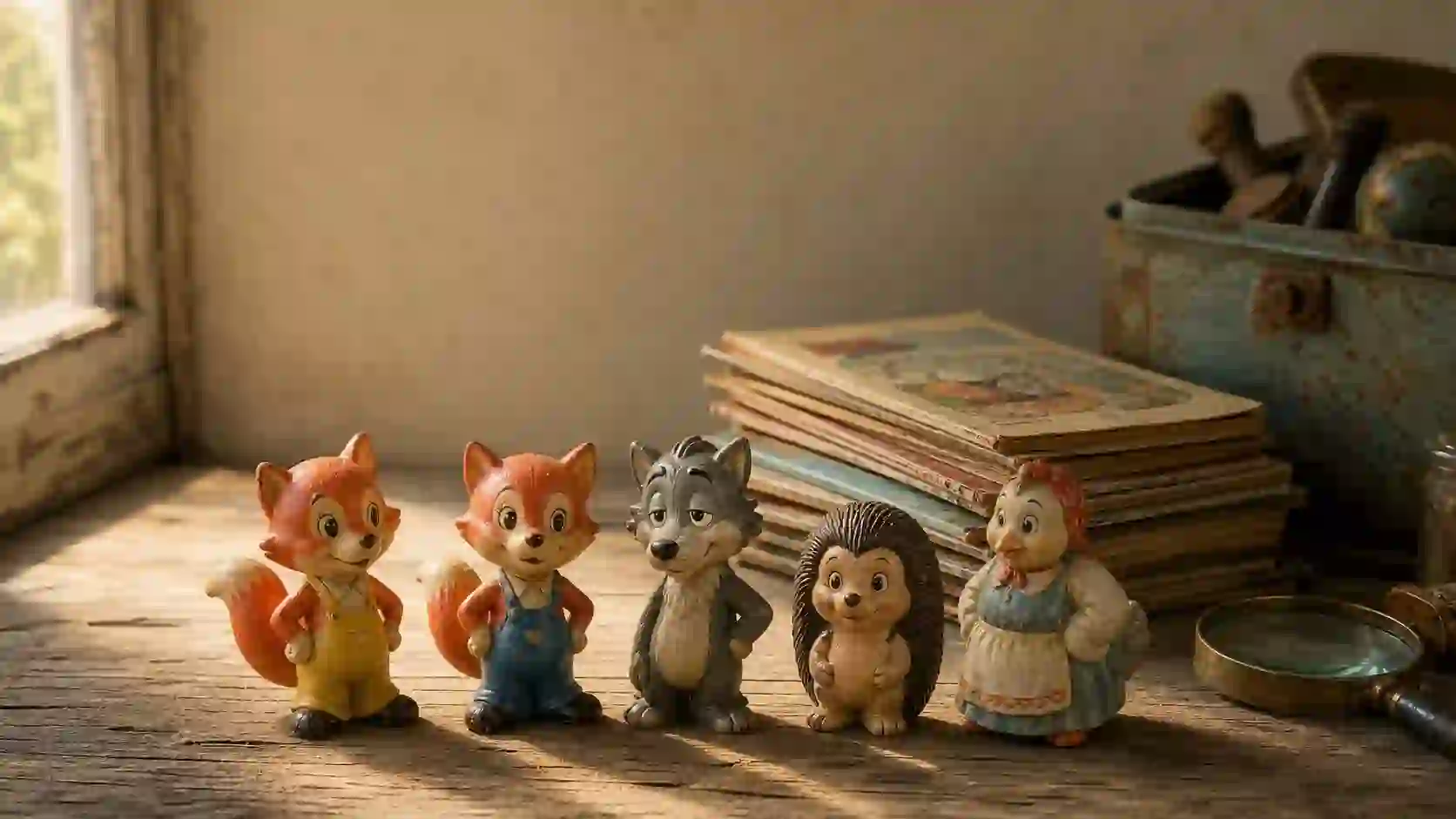
Your figures cost €4 or €400, and the difference hides under the foot. Most Fix und Foxi Figuren look identical in a shoebox: orange foxes, yellow overalls, chipped paint. The price follows details nobody photographs at flea markets — the maker mark, the squeaker valve, the mold, the pose. This guide shows you how to read those details, date your pieces, price them honestly and keep them intact for the next seventy years.
Quick answers for busy collectors
- Fix und Foxi Figuren come from licensed German toy makers of the 1950s to the 2000s, not one single brand: John, Heimo, ZEK, Fischer, Schuco, Bullyland.
- The mark under the foot decides more than the paint does. “Heimo-Emblem © R. Kauka” is the one collectors hunt for.
- Common hard-plastic singles trade between roughly €2 and €15; large squeakers and rare characters run €20 to €50 and higher.
- Fix wears yellow overalls and white shoes with a tuft of hair. Foxi wears blue overalls, yellow shoes and short hair.
- Working squeaker plus intact accessories raises value; repainting destroys it.
What Fix und Foxi Figuren actually are
Rolf Kauka (1917–2000) built the fox twins as a German-language answer to Disney comics. The duo appeared in the series Till Eulenspiegel from 1953 and took over the magazine title in 1955.
Toy makers moved with the magazine. Kauka licensed his cast to small West German plastics firms and to East German combines, and those licenses produced the figures people now fight over in online carts.
Because the brand sat on newsagent shelves for four decades, the toys changed with it: squeaky hollow rubber in the 1950s, hand-painted plastic in the 1970s, wind-up novelties with the year 2000. Learn the eras and Fix und Foxi Figuren stop being a random heap.
The cast you need to recognise before you buy
Collectors price by character as much as by maker. Learn these seven names and you can read most listings in ten seconds.
- Fix — the quick one, yellow overalls, white shoes, hair tuft on the forehead.
- Foxi — the careful twin, blue overalls, yellow shoes, short hair.
- Lupo — the wolf in the Mouse Tower, the laziest character in the cast and the most common figure in circulation. He was spelled “Lubo” until 1955.
- Lupinchen — Lupo’s cousin, often sold in sets with a paper or plastic flag.
- Oma Eusebia — the grandmother, named as Eusebia in issue 165 of 1959.
- Professor Knox — the absent-minded inventor, and one of the harder faces to find among Fix und Foxi Figuren. His Heimo version is a strong buy at any fair price.
- Pauli — the little hedgehog from the side stories, beloved in the Swabian edition of the magazine.
Names and poses are the shortlist for your search box. Sellers rarely write full sentences, so learn the shorthand: “Kauka Figur”, a character name, a decade, a maker.
Pose matters too. A Fix carrying a parcel, a suitcase, a hockey puck or a money sack each represents a separate mold, and the odd poses cost more than the standing versions.
How to identify authentic Fix und Foxi Figuren
Read the underside first. Everything else is opinion.
Marks to look for
- Heimo figures carry an embossed “Heimo-Emblem © R. Kauka” under the foot — the clearest proof you can get from a 1960s or 1970s piece.
- Squeakers from the 1950s were produced by John Thermoplastik for Rolf Kauka; they feel heavier, sit taller and often still hold their valve.
- East German pieces from ZEK GmbH in Plauen are hard plastic, frequently supplied with a small flag.
- Later figures may carry only “© Rolf Kauka Prod.” or a copyright year; missing marks are normal, not automatically fake.
Physical checks
- Hand-painted faces show brush lines and slightly uneven eyewhites; printed decals on a “vintage 1955” figure mean a later or foreign product.
- Hollow rubber squeakers flex under gentle thumb pressure. Rigid, waxy new plastic does not.
- Paint losses on a licensed figure usually follow the mould edge, because the factory spray wore there first. Random chips across the back of a “mint” piece suggest stage-managed ageing.
- Weigh duplicates. Licensed molds have a consistent heft; cheap re-runs feel airy.
Red flags
- “Reproduction”, “Replica” or “Deko” in the seller’s own title.
- A shiny, solvent-smelling surface on a supposedly 60-year-old toy.
- Foot sanded smooth — sometimes accident, sometimes concealment.
- A price that ignores condition entirely.
Most overpriced Fix und Foxi Figuren fail on one point alone: the seller copied an asking price from a listing with no sold history. Check what closed, not what is advertised.
Six decades of makers, at a glance
Kauka never manufactured toys himself. He licensed artwork and let the plastic industry do the heavy lifting.
West Germany
- John Thermoplastik made the big squeakers of the 1950s and 1960s, up to about 22–26 cm tall.
- Heimo dominated the 1960s and 1970s with small hand-painted figures around 5 cm, plus larger poses.
- Fischer and ELA appear on listings for rubber and plastic characters from the same decades.
- Schuco entered with the Bigo-Bello line, roughly 24 cm.
- Bullyland later produced small collectible characters sold at checkout counters.
East Germany
- ZEK GmbH in Plauen pressed hard-plastic figures for the GDR market, and those pieces surprise many western collectors with their quality.
Promotion and premium
- RENO and other food brands used Lupo on keychains and advertising figures.
- The McDonald’s promotion of 2000 added wind-up figures around 9–12 cm.
- Pichelsteiner-branded characters such as Neo sit in a niche of their own and rarely come cheap.
That spread explains why Fix und Foxi Figuren stay fun to hunt. The maker decides what you hold, and the maker is the one detail small listings leave out most often.
Fix und Foxi figures by maker: identification and price table
Prices below are ranges I read from live German listings in September 2026. Asking prices are not sold prices, so treat them as a starting point and negotiate accordingly.
| Maker and era | Material | Typical height | What proves authenticity | Realistic price band |
|---|---|---|---|---|
| John Thermoplastik, 1950s–1960s | Hollow rubber, squeaker | 16–26 cm | Original valve in base, Kauka licence, aged matte surface | €19–€69 |
| Heimo, 1960s–1970s | Hard PVC, hand painted | 4.5–8 cm | Embossed “Heimo-Emblem © R. Kauka” under foot | €1.50–€15 |
| Heimo rare characters (Knox, Eusebia) | Hard PVC | 5–8 cm | Same foot mark, uncommon mold | €20–€50 |
| ZEK GmbH (GDR), 1960s–1980s | Hard plastic | 5–7 cm | Original flag, East German tooling, thin seam | €10–€45 |
| Fischer / ELA, 1960s–1970s | Rubber or plastic | 6–12 cm | Period paint wear, Kauka copyright line | €5–€35 |
| Schuco Bigo-Bello, 1980s | Plastic | ~24 cm | Schuco branding plus Kauka licence | €25–€60 |
| Bullyland, 1990s–2000s | Plastic | 5–7 cm | Bullyland base stamp, modern crisp moulding | €1–€20 a piece |
| McDonald’s promo, 2000 | Plastic, wind-up | 9–12 cm | © 2000 Rolf Kauka marking, side key | €10–€16 a set |
| Pichelsteiner promo figures | Plastic | 6–10 cm | Brand print plus Kauka licence | €20–€70 |
What drives value in Fix und Foxi Figuren
Five factors move the number on the price tag.
- Mark and maker. A Heimo foot stamp turns a €2 guess into a €12 figure.
- Character. Knox, Eusebia and the odd Pichelsteiner molds sit above Lupo, who was produced in quantity for years.
- Pose and props. A parcel, a skatboard or a flag adds a mold, and moulds are what collectors chase.
- Condition. Paint on the face, intact ears, working squeaker, no cracked base. Ten percent of buyers forgive a missing hat; none forgive a repainted face.
- Provenance. A family story with photographs, or an original box, nudges the price up and shortens the argument.
Run those five factors over Fix und Foxi Figuren and the pricing stops looking random. Auction records show how far the ceiling stretches: original Kauka production drawings from the Rolf Kauka collection sold at Sotheby’s Munich in February 2007, mostly in the hundreds of euros.
That is artwork, not plastic. The toy market stays affordable, and that is exactly why new collectors keep arriving.
Common figures versus rare ones
Plentiful
- Lupo sitting or lying, Heimo version.
- Foxi standing, 5 cm, repaint worn.
- Bulk lots of six mixed characters, sold by weight as “collection”.
Genuinely scarce
- John squeakers where the squeak still works.
- Unpainted Heimo blanks (“Rohlinge”) in single colours, which collectors debate and still buy.
- ZEK figures with their original flag intact.
- Large Knox and Eusebia figures with original faces.
Buying the plentiful group costs little. Selling the scarce group well costs patience. List rare pieces in January or in the run-up to a comic convention, when serious buyers have cash and nothing to browse.
Where and how to buy: a field checklist
German marketplaces carry most stock, and the search terms you use change what you find.
- Search “Rolf Kauka Figur”, “Kauka Heimo”, “Fix und Foxi Quietschfigur” and “Lupinchen ZEK” as well as the character names. Many sellers never write “Fix und Foxi” at all.
- On Kleinanzeigen, filter for your region and inspect in person. Photograph the foot before you pay.
- On eBay, read the seller’s other listings. Someone who sells dozens of Kauka figures knows their stock and prices it properly; someone clearing one attic box often prices high.
- Oldthing and specialist toy auction houses surface the early John pieces more reliably than general platforms.
- Ask for the item in daylight, out of packaging, in one unedited photo. Flashlight photos hide cracks.
- Book local pickup only when the listing shows the mark. Otherwise you waste petrol.
Never accept “as seen in the photo” for a €60 purchase without a close-up of the base. That single request filters out half the trouble.
Storage, cleaning and display that protect value
Vintage Kauka plastics age badly in good homes, not attics.
- Keep figures out of direct sun. Orange fox paint fades to a washed apricot within a few summers on a south-facing shelf.
- Display on glass, ceramic or sealed wood. Old soft plastics and PVC can migrate plasticisers into paint, and a figure that fuses to a vinyl mat loses a finish you cannot correct.
- Dust with a dry, soft brush. Wash only in lukewarm water with a drop of mild detergent, then dry immediately, and never wet a squeaker.
- Store each figure loose, wrapped in acid-free tissue. Newspaper storage transfers print and yellows paint, a pattern that turns up on decades of recovered boxes.
- Keep broken parts in a labelled bag glued to the base of the display. A detached flag is recoverable value; a thrown-away one is a permanent discount.
- Handle painted faces sparingly. Skin oil dulls the eyewhites first.
Should you repair or restore your figures?
Clean, yes. Repaint, no. Collectors pay for honest age, and a fresh coat of acrylic reads instantly, especially on the tail and ears where the original spray is thin.
- Glue cracks with a removable fixative rather than superglue, so the next owner can undo your work.
- Leave the squeaker alone if the valve is torn; a silent figure with its original skin beats a repaired one.
- Fill nothing, sand nothing, and never remove a marking, even a smudged one.
- Get a specialist to fill losses only when the piece is a scarce mold in top condition; otherwise the invoice exceeds the value.
Three flea market moves that work
- Arrive early, then come back at 16:00. Sellers discount the leftovers they do not want to carry home, and a €15 figure becomes €8 without an argument.
- Bring a torch and look under the foot before you touch the price. Saying “I can see the Heimo mark” changes a negotiation faster than any offer.
- Ask for the whole box, not the item in front of you. Attic lots contain the pieces a seller never listed, and half of them are better than the table stock.
A fair price in 30 seconds
Skip the bidding war and use the three boxes below.
- €2 to €12 — one small hand-painted figure, any common character, honest paint losses.
- €20 to €60 — a working squeaker, a rare character, or a clean Heimo set of five with matching marks.
- €80 and up — five figures only when they are early, boxed, or a mold that surfaces twice a year.
A bundle of ten mixed singles is worth less per piece than the same figures sold one by one, and more per hour of your weekend. Choose which of those two you actually need.
If a seller refuses close-ups of the base, close the tab. Every honest Kauka figure seller I have bought from sent the foot photo before I asked twice.
“Total fix und foxi”: the phrase, the region and the market
The foxes outgrew the magazine. In everyday German, “total fix und foxi” means completely exhausted, and people who never read a comic still use it. Collectors I have met in Bavaria trace a fondness for the characters to the Swabian and southern editions of the magazine, where the hedgehog Pauli held a permanent slot.
That regional memory shapes prices in practical ways:
- Bavarian and Baden-Württemberg sellers list more Heimo pieces and start them lower, because the stock is deeper there.
- Northern and western listings show more early squeakers, and those sellers know it.
- Austrian and Swiss platforms surface GDR-era ZEK figures more often than German ones do, sometimes at half the price.
If you live within reach of a second country’s marketplace, use it. Half an hour of cross-border searching found me two Knox figures for the price of one, and a seller who had no idea what mark sat under the foot.
Collect or sell? A decision in two questions
Question one: do you want the shelf or the money? Display wins when a figure carries a family memory or a scarce mold, because nostalgia plus rarity is the only combination that reliably rises in interest. Selling wins for double-ups, worn faces and mixed lots, where the value sits in the pile rather than in any single piece.
Set a floor price before you list anything. Fix und Foxi Figuren sit in a narrow band, so a €8 piece does not become a €30 piece by asking — it sits unsold for four months while a €10 listing closes in a week.
Question two: what is your weakest piece worth as a bundle? Three chipped Heimo figures sell slowly at €5 each and quickly at €12 for the lot. Bundling is the fastest route to cash in this niche.
The good news: Fix und Foxi Figuren remain cheap to enter and cheap to house. A start collection of eight figures fits in one drawer and cost me less than two cinema tickets.
Why this niche is heating up now
Your Family Entertainment in Liechtenstein holds the rights and runs the official Fix & Foxi site, which notes more than 780 million copies sold. The company acquired the catalogue in 2014 and launched a Fix & Foxi channel that December.
In March 2026 the brand announced an official online shop. New merchandise means new attention, and fresh buyers start hunting the vintage originals no shop will ever reprint.
Two practical consequences for you:
- Fresh traffic lifts searches for the old toys. Fix und Foxi Figuren in the €5 bargain heap thin out a little every season, and my local market ran out of squeakers in one afternoon in July 2026.
- Modern reproductions and re-releases enter the second-hand market, and beginners confuse them with vintage stock. Learn the foot marks now, before the mix gets worse.
FAQ: your Fix und Foxi figure questions answered
What are Fix und Foxi Figuren?
They are the licensed toys of Rolf Kauka’s comic foxes, made in Germany from the 1950s to the 2000s by firms such as John, Heimo, ZEK, Fischer, Schuco and Bullyland, in rubber, hard plastic and wind-up novelty form.
How do I know if my figure is original?
Check the underside for a mark. An embossed “Heimo-Emblem © R. Kauka”, a Kauka copyright line or a John licence, plus hand-painted faces and period wear, points to an original production. Ask a seller for that photo before bidding.
Which Fix und Foxi figures are the most valuable?
Large hollow-rubber squeakers from the 1950s and 1960s with a working valve, rare characters like Professor Knox and Oma Eusebia, ZEK pieces with original flags and scarce promotional molds such as Pichelsteiner. Most everyday singles stay under €15.
Can I still find Fix und Foxi Figuren in Germany?
Yes, weekly. Kleinanzeigen, eBay.de, oldthing, flea markets around the Rhine-Ruhr region and Bavaria, and comic swap meets all surface Kauka stock. Bulk attic lots appear most often in January and after house clearances.
How should I store and clean them?
Keep them out of sunlight on glass or sealed wood, dust with a soft dry brush, wash only with lukewarm water and mild detergent, and never soak a squeaker or strip an old marking.
Are Fix und Foxi figures safe to give to a child to play with?
For display and gentle nostalgia, fine. For real play, no. Sixty-year-old plastics have unknown additives, brittle parts can splinter into choking pieces, and vintage paint may contain pigments banned today. Choose modern licensed figures for small hands.