Tiefling Guide: Names, Lore, Traits and How to Build One
A tiefling is one of the most popular playable lineages in Dungeons & Dragons, and for good reason. They look unforgettable, they carry a built-in story hook, and they give you plenty of room to play someone heroic, conflicted, curious or all three at once. Have you ever wanted a character who feels like an outsider on day one but has every reason to prove people wrong? That is exactly the space they fill.
If you searched for tiefling dnd advice, you probably want more than a stat block. You want to know how to make the character feel real at the table. This guide is written for beginners and experienced players alike. You will get clear lore, practical build advice, naming ideas and roleplay tips you can use right away.
Quick Overview
- Origin: Descendants of humans touched by infernal power, bound to the Nine Hells through a pact or curse in their bloodline
- Look: Horns, a tail, unusual skin tones, glowing eyes and other infernal features that make them easy to spot in a crowd
- Traits: Darkvision, resistance to fire damage, and innate spells like thaumaturgy, hellish rebuke and darkness in most versions
- Subraces: Asmodeus, Mephistopheles and Zariel lineages offer different spells and flavour, plus newer variants from Monsters of the Multiverse
- Best fit: Warlocks, sorcerers, rogues, paladins and bards who want charisma, magic or a dramatic backstory
- Core idea: They are not born evil. Their choices, not their blood, decide who they become
What Is a Tiefling in D&D?
In Dungeons & Dragons, this lineage is a human-descended people shaped by infernal influence. Long ago, a human group made a pact with the archdevils of the Nine Hells, or was cursed by them, and that mark passed down through generations. The result is a people who carry a visible sign of that bargain in their horns, tails and skin.
That history matters because it shapes how the world sees them. Many townsfolk assume anyone with infernal features must be wicked or dangerous. People with this heritage often grow up hearing that suspicion, and they have to decide whether to lean into it, fight it or ignore it completely. That tension is why they work so well as player characters.
In simple terms, this lineage means someone whose ancestry was altered by a connection to the Nine Hells. The change is physical and magical, but it does not control their personality or morals.
You might wonder why the lore changed over editions. Earlier books tied the lineage closely to Asmodeus, the ruler of Nessus. Later books, especially Mordenkainen Presents: Monsters of the Multiverse, opened the door to other archdevils like Mephistopheles and Zariel. That shift gave players more choices without erasing the original story.
Think of it like this. The pact is the starting point, not the ending. Your character can honour it, resent it, try to break it or never think about it at all. The lore gives you a question to answer, and your play gives the answer.
What Do They Look Like?
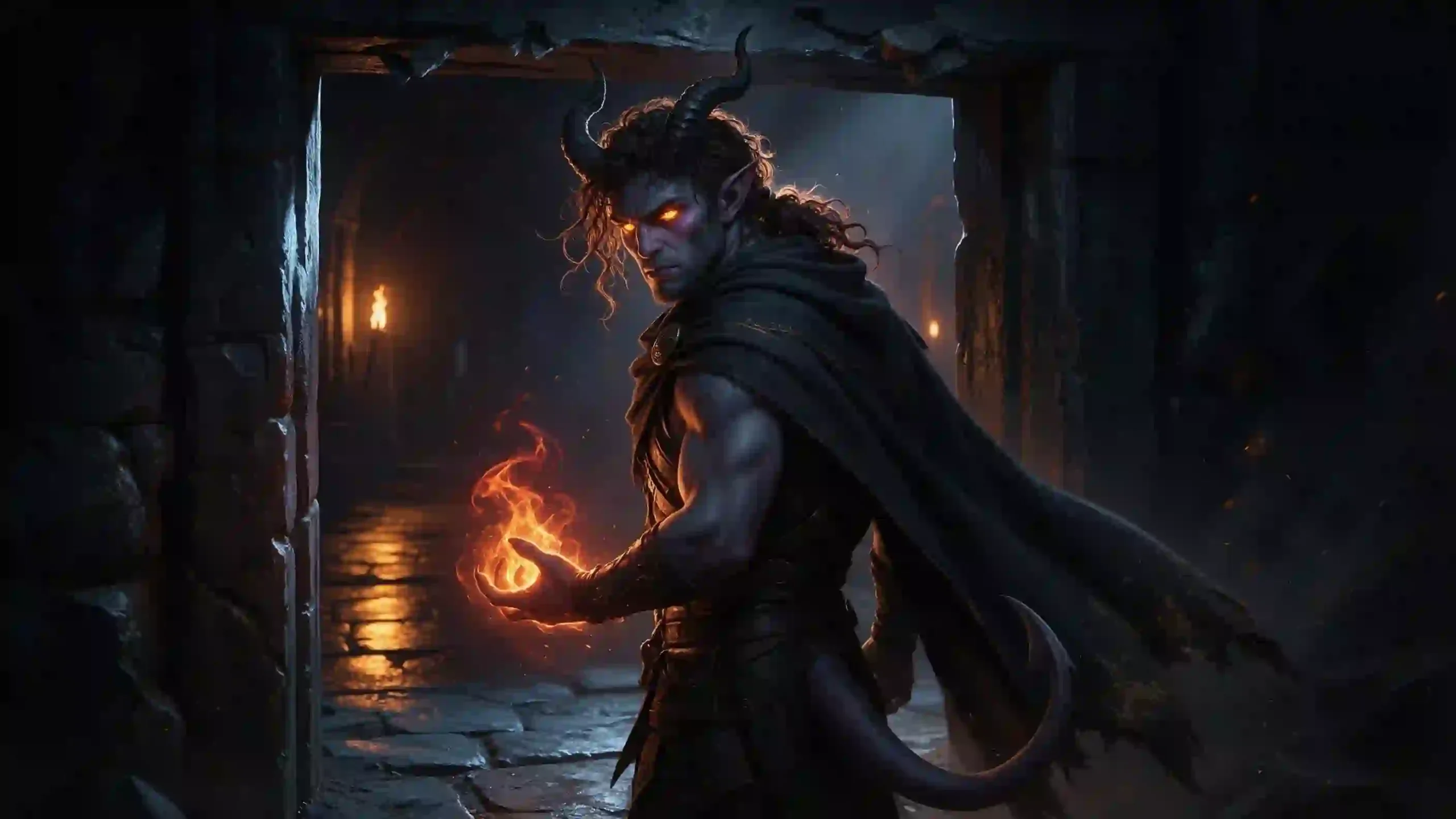
If you picture one, you probably picture horns first. Most have a pair of curved horns that grow from the forehead, though the size and shape vary a lot. Some have short, stubby horns. Others have long, sweeping ones that curl back like a ram.
No two sets need to look alike.
The tail is the next giveaway. It is usually long, thin and flexible, ending in a spade or arrow-like tip. Characters often use it without thinking, curling it around a chair leg or flicking it when annoyed. It adds a lot of life to a scene, even if you only mention it now and then.
Skin tones range widely. You will see deep reds, rusty oranges, pale greys, ashen blues and even more unusual shades. Eyes often glow with a solid colour, like amber, red or white, and they stand out in low light. Teeth can be sharp, and some have small fangs that show when they smile.
Height and build are similar to humans, which helps them blend in until you look closer. Ears are often pointed, and some have ridges or small horns on the chin or cheeks. A few have extra features like a third eye, a forked tongue or faint infernal markings that appear when they cast spells.
Small Details That Make Them Feel Real
Clothing and grooming tell a story too. A character who grew up being stared at might keep horns polished and wear high collars to draw less attention. Another might lean into the look with bold colours and jewellery that frames the horns. What does your character do, and why?
A Quick Visual Comparison
| Feature | Typical Trait | Variation You Can Use |
|---|---|---|
| Horns | Curved pair on forehead | Short nubs, long ram-like curls, asymmetrical shapes |
| Tail | Long, prehensile, spade tip | Shorter tail, barbed tip, expressive and restless |
| Skin | Red, grey, blue or ashen tones | Mottled, striped or with faint glowing runes |
| Eyes | Solid colour, often glowing | Heterochromia, dark sclera, light that brightens with emotion |
| Teeth | Slightly sharp canines | Small fangs, forked tongue, mouth ridges |
None of these details are required in a strict sense. The rules give you a baseline, and your imagination fills in the rest. If you want feathered horns or a tail that glows faintly, talk to your Dungeon Master and see what fits your table.
What Are Their Traits and Subraces?
In fifth edition, they share a core set of traits that reflect their infernal heritage. They have darkvision, which lets them see in dim light and darkness as if it were bright light, up to 60 feet. They also resist fire damage, which makes sense given their connection to the Hells.
Most versions also grant innate spellcasting. Thaumaturgy is the classic cantrip, a small display of magic for minor effects. Hellish rebuke lets them strike back with fire when struck, and darkness gives them a reliable way to hide, escape or create cover. The exact spells depend on the subrace you choose.
The Three Main Lineages
The Asmodeus lineage is the original. It is tied to Asmodeus himself and focuses on fire, punishment and control. Its spells include hellish rebuke and darkness, with infernal legacy at higher levels. This is the safest pick if you want the classic feel.
The Mephistopheles lineage comes from the archdevil of Cania, who values knowledge and cold calculation. Its spells lean toward mage hand, burning hands and legacy of the frost. It suits a character who is clever, patient and a little icy, even if their skin runs warm.
The Zariel lineage is the most dramatic. Zariel was once a solar who fell and became an archdevil, and her descendants carry that fall in their look and magic. They often have a more radiant or warlike flavour, with spells that hit hard and protect allies. Paladins and warlocks love this option.
How the Traits Work in Play
Darkvision sounds simple, but it changes how you explore. You can take point in a dark tunnel, read a note in a moonlit ruin or spot an ambush before others do. Fire resistance is also practical. It helps against dragon breath, fire traps and spells, though it will not save you from lava or a burning building on its own.
Innate spells are limited, so you will want to use them wisely. Thaumaturgy is for flavour and small tricks. Hellish rebuke is best saved for a moment when you want to punish an attacker and make a statement. Darkness is powerful, but remember that it blocks light for everyone, including your friends.
A Real Example at the Table
Imagine a Zariel paladin named Kael who enters a goblin camp at night. His darkvision lets him see the sentry on the wall. He casts darkness to cover the party’s advance, then uses hellish rebuke when the goblin chief lands a blow.
The chief’s torch does not hurt him as much as expected because of his fire resistance. None of this makes him overpowered. It just gives him clear moments to shine.
How Do You Build a Tiefling Character?
Building a strong character starts with a clear idea, not a perfect stat spread. Ask yourself what role you want to fill in the party. Do you want to be the face, the blaster, the sneaky one or the frontline protector?
Many dnd tiefling builds start with class, not stats. Your answer will guide your class and subrace choices.
Next, think about ability scores. Charisma is often the star for infernal lineages because so many of their spells and class features rely on it. Dexterity helps rogues and ranged fighters. Constitution keeps everyone alive longer.
You do not need perfect scores. A focused build beats a scattered one every time.
Step-by-Step Build Process
- Choose your class first, then pick a lineage that supports it.
- Pick a subrace that matches your story.
- Decide on your background for skills and contacts.
- Assign your innate spells to moments, not just combat.
- Write a short backstory hook about the pact or family.
- Talk to your Dungeon Master about lore in their world.
Warlocks, sorcerers and bards love charisma. Paladins love Zariel flavour. Rogues love the sneaky, charming angle. Asmodeus suits classic fire.
Mephistopheles suits cold intellect. Zariel suits fallen-radiant drama. A charlatan, soldier, hermit or noble past gives you skills that shape play more than any single spell.
Plan one social use, one exploration use and one combat use for each innate spell. One paragraph about the pact, the curse or the family expectation is enough for a backstory hook. Leave room to grow. That chat with your Dungeon Master will save confusion later.
Class Synergies Worth Trying
Warlocks are the obvious match, and for good reason. The pact story mirrors the class story, and charisma powers both. A fiend warlock with Asmodeus lineage feels like the pact is in their blood and their contract at once.
That can be powerful, but it can also be a lot of pressure. Do you want that weight?
Sorcerers work well too, especially those with wild or draconic magic. The idea of magic in the blood fits perfectly. A Mephistopheles sorcerer who studies cold, precise magic feels very different from a Zariel sorcerer who channels raw, falling-star energy. Same lineage, different person.
Rogues and bards bring out the social side. A rogue who grew up being distrusted might use charm and misdirection to get by. A bard who leans into their look can turn suspicion into applause. Think about how your character uses their appearance, not just how they look.
Paladins deserve a mention because they challenge assumptions. A Zariel paladin who swore an oath to protect people despite their heritage is a great story. They prove every day that an oath matters more than ancestry. That kind of character often becomes the heart of a party.
Common Build Mistakes to Avoid
One mistake is trying to do everything. If you spread your stats thin, you will feel average at the moments that matter. Another mistake is ignoring the story. A character with no reason to adventure will struggle to stay engaged, no matter how good the numbers look.
A third mistake is copying a build without asking why it works. Read the class features, test the idea in a one-shot if you can, and adjust. Your table’s style matters more than any guide, including this one. What feels fun for your group?
What Are Good Names for Them?
Names do a lot of work in D&D. They tell the table how your character sees themselves and how others see them. For names, you have three main wells to draw from: virtue names, infernal-sounding names and names from the culture they grew up in.
Virtue names are the most distinctive. They are single words that describe a quality, often with a twist. Hope, Creed, Faith, Glory, Karma, Lament, Poetry, Ruin, Sorrow, Verity and Zeal are all classic examples.
The idea is that parents or guardians give a child a virtue name as a wish or a warning. Will you live up to it?
Infernal-sounding names lean into the Nine Hells. They often have hard consonants, rolled sounds or a formal feel. Think of names like Azazel, Belial, Carnifex, Dusk, Malphas, Ravok, Severin or Vesper.
You do not need to use a demon name from a book. A name that sounds old and weighty will do the job.
How to Pick a Name That Fits
Start with the story. Was your character raised in a human town, a hellish court or a mixed community? A human-raised character might have a human first name and a virtue nickname. A hell-raised character might have a formal infernal name and a short call name for friends.
Try saying the name out loud. Does it roll off the tongue? Can other players remember it after one session? A name that is cool on paper but hard to say will get shortened anyway, so you might as well pick a short form you like.
Examples by Style
For virtue names, consider Hope, who tries to stay optimistic despite the odds. Consider Lament, who sings sad songs and collects stories of loss. Consider Creed, who is strict about promises.
Consider Ruin, who is reckless and honest about it. Each name suggests a personality before the character speaks.
For infernal names, consider Vesper for an evening-star feel, Ravok for a harsh, military sound, or Dusk for something quiet and watchful. Pair it with a title or epithet if you like, such as Vesper the Unbowed or Ravok of the Ashen Gate. Titles give you extra flavour without extra rules.
For human-raised names, mix cultures. A character named Mara Creed or Jonah Hope feels grounded and easy to roleplay. A character named Asha Vesper feels like they bridge two worlds. What mix matches your backstory?
A Simple Naming Exercise
Write down three virtue words you like. Write down three infernal sounds you like, like -az, -ex, -or or -in. Combine them and test the results. Next, decide which one inspires you to take on the role.
If you smile when you say it, you have probably found the right one. That feeling matters more than any list. Good names are the ones you want to hear called across a crowded tavern scene.
How Should You Roleplay Them?
Roleplay starts with a simple question: what does your character want? Not what their lineage wants, not what the party wants, but what they want. A character who wants to be trusted will act differently from one who wants to be feared. A character who wants to leave the past behind will act differently from one who wants to reclaim it.
Many players lean on the outsider angle, and it works because it is true to the lore. Being stared at, questioned or feared can shape a person. It can make them guarded, defiant, charming or tired. The key is to show the effect without making every scene about it.
Avoiding Stereotypes While Still Using the Lore
It is easy to fall into a narrow groove: brooding, evil, seductive or always angry. Those traits can fit a character, but they get old fast if they are the whole personality. Try adding a counter-trait. A fierce warrior who loves baking.
A smooth talker who is terrible at lying to friends. A brooding scholar who collects jokes and tells them badly.
Think about habits, not just traits. Does your character fidget with their tail when nervous? Do they check their horns in a mirror before a big talk? Do they avoid eye contact with guards because of past trouble?
Small habits make a character feel real in a way that big speeches do not.
Social Play and Party Dynamics
In social scenes, your character’s look will come up. That is fine. You can decide how they handle it. Some will answer questions with patience.
Some will deflect with humour. Some will get sharp and set a boundary. All three are valid, and the choice tells the table a lot.
With the party, trust is earned. A good way to show it is to be reliable in small moments. Keep watch without complaint. Share information you learned.
Use your darkvision to help others. Those small acts build more trust than any grand speech about being good.
A Scene You Can Try
Imagine your character enters a village market for the first time. A child points and asks about the horns. An older guard watches closely. A merchant offers a discount with a nervous smile.
How does your character respond to each person?
A warm answer to the child, a calm nod to the guard and a polite thank you to the merchant shows range. You do not need a fight or a spell to make the scene memorable.
Are They Good or Evil?
No. They are not inherently good or evil, and that is one of the most important ideas in their lore. Their infernal heritage gives them a history and a set of traits, but it does not set their morals. A person with this heritage can be a devoted healer, a ruthless villain, a neutral wanderer or anything in between.
This matters because the world in the game often gets it wrong. Townsfolk may assume the worst. Some may even lean into that assumption because it gives them power or because they are tired of fighting it.
But the assumption is not the truth. Your character’s alignment, if you use it, should come from their choices.
How Alignment and Morality Work Here
In D&D, alignment is a tool, not a cage. You can play a lawful good paladin who keeps every promise. You can play a chaotic neutral rogue who follows their own code. You can play a lawful evil warlock who serves a strict master.
The lineage does not lock you into any of those paths.
What matters more is the character’s personal code. What do they believe? Who do they protect? What line will they not cross?
Answer those questions and you will have a moral compass that feels honest, even if the world disagrees.
Story Hooks That Explore the Question
A strong hook is a choice tied to the pact. Maybe your character was offered power and refused. Maybe they accepted and now regret it. Maybe they never knew about the pact until a devil showed up to collect.
Each option leads to a different story.
Another hook is family. Did your character’s parents embrace their heritage or hide it? Were they raised by humans, by others like them or by a devil? Family shapes values more than blood does.
A character raised by a kind human priest will see the world very differently from one raised in a hellish court.
A Comparison of Common Paths
| Path | What It Looks Like | Story Question It Raises |
|---|---|---|
| The Rebel | Rejects the pact and proves people wrong | Can you outrun a legacy you did not choose? |
| The Embraced | Leans into infernal power and pride | What does power cost when you enjoy it? |
| The Seeker | Searches for the truth behind the curse | Who made the bargain, and can it be undone? |
| The Bridge | Lives between human and infernal worlds | Who do you belong to when both sides doubt you? |
None of these paths is better than the others. The best one is the one that gives you scenes you want to play. Pick a path, then let the party and the world push back. That pushback is where the story lives.
Key Takeaways
- They are human-descended people marked by infernal influence, not born villains. Their story is about choice, not destiny.
- Horns, tails, glowing eyes and varied skin tones are the visual core. Small habits and grooming choices make them feel real.
- Darkvision, fire resistance and innate spells give them clear strengths in exploration, combat and social play.
- Asmodeus, Mephistopheles and Zariel lineages offer different magic and flavour. Pick the one that matches your class and story.
- Virtue names, infernal names and mixed cultural names all work, and roleplay works best when you focus on wants, habits and personal codes, not just stereotypes or outsider pain.
Frequently Asked Questions
What is a tiefling in D&D?
This lineage in D&D is a playable lineage of human descent touched by infernal power from the Nine Hells. They have horns, tails, darkvision, fire resistance and innate spells. Their lore centres on a pact or curse in their ancestry, but their morals and choices are their own.
What are tiefling names like?
Names often come from three styles: virtue names like Hope, Creed and Ruin; infernal-sounding names like Vesper, Ravok and Dusk; or mixed names that blend human and infernal sounds. Pick a name that fits your backstory, sounds good aloud and is easy for the table to remember.
Are tieflings good or evil?
Tieflings are not inherently good or evil. Their infernal heritage shapes their appearance and magic, not their morals. They can be heroes, villains or anything in between. What defines them is their personal code, their choices and how they respond to a world that often judges them unfairly.
What classes work best for them?
Warlocks, sorcerers, bards, rogues and paladins work especially well because they use charisma, magic or a dramatic story. Zariel paladins, fiend warlocks and Mephistopheles sorcerers are strong examples. The best class is the one that matches the character you want to play and the role your party needs.
What is the difference between subraces?
Asmodeus, Mephistopheles and Zariel subraces differ in spells and flavour. Asmodeus focuses on fire and punishment. Mephistopheles focuses on cold, precise magic and knowledge. Zariel focuses on radiant, warlike power tied to a fallen angel, so choose based on story and class synergy.
Can they be heroes?
Yes, they can absolutely be heroes. Many of the most memorable characters in D&D are people with infernal heritage who protect others, keep oaths and prove that ancestry does not decide morality. Their outsider status often makes their heroism more powerful, because they choose kindness despite suspicion and hardship.
Conclusion
A tiefling gives you a look people remember, magic people feel and a story people want to follow. The horns and tail are only the start. What matters is the person underneath, the choices they make and the promises they keep when no one is watching.
If you are building one now, start with a want, a name and a single story hook. Then let the table do the rest. The best characters grow in play, and infernal blood is a great place to begin. Who will yours become?
Keep Reading
What Is A Dangerous Deal and The Girl Next Door Raw? Story, Characters and Reading Guide
Is Someone Stop Her Toongod Worth the Hype? Complete Story, Characters, and Reading Guide
Taiyo’s Sisters-in-Law Need His Seed: What Is the Manga About?

What Is Hentai20? Complete Reader And Safety Guide

A Cultivation Master Starts a New Account in Another World: The Complete Pillar Guide