Tokyo Ghoul Manga vs Anime Differences: Which Version Is Better?
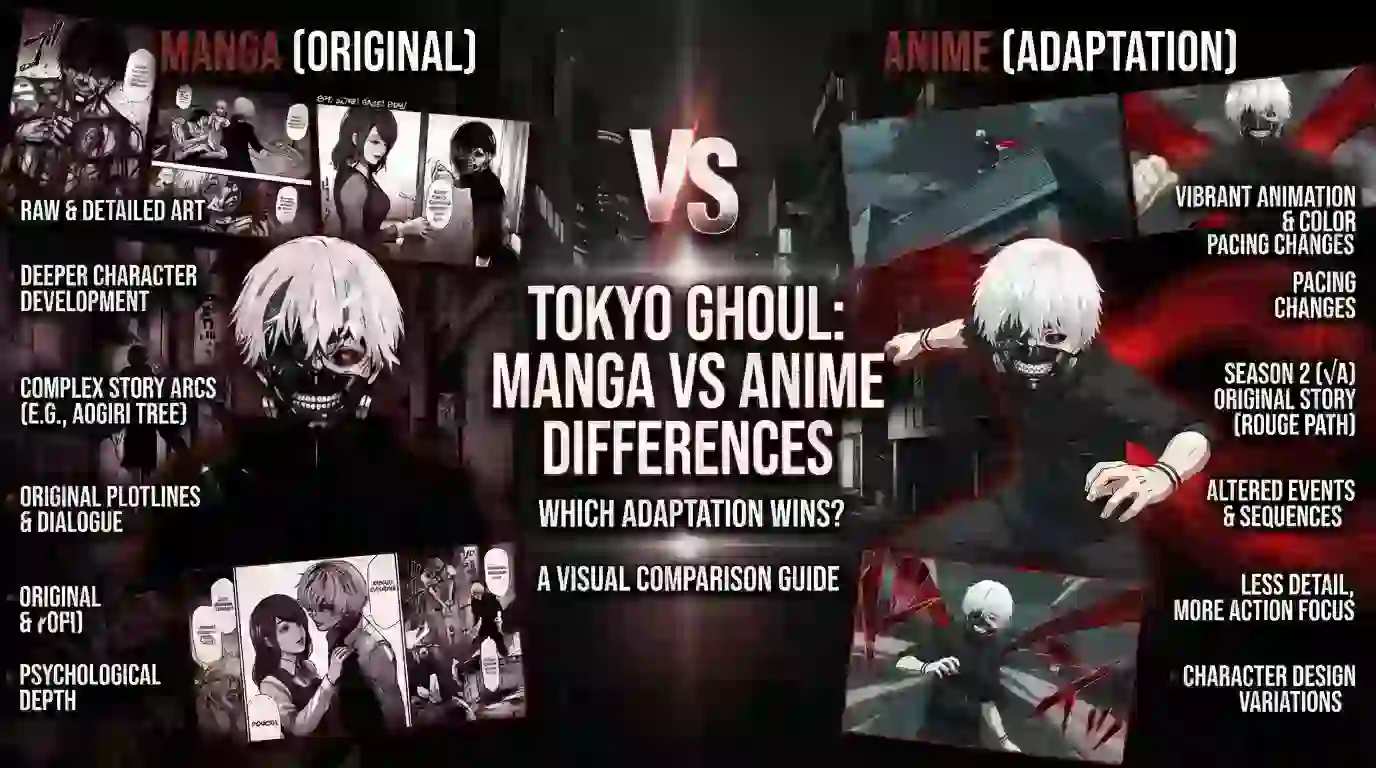
Many fans finish the anime and still ask why the story feels rushed, especially once Tokyo Ghoul:re begins. The problem comes from more than missing scenes: the adaptation changes Kaneki’s path, compresses supporting characters, and follows an anime-original route in Tokyo Ghoul √A. This guide maps the story cuts clearly so you can choose the right version and understand where the timelines split.
What are the biggest Tokyo Ghoul manga vs anime differences?
The manga tells a more complete, carefully layered story, while the anime delivers a faster and more visual version with major omissions. Season 1 follows the manga’s broad foundation, but Tokyo Ghoul √A changes Kaneki’s route; Tokyo Ghoul:re then compresses a large amount of manga material into a short television run. If you want the clearest character motives, read the manga first or use it to fill the anime’s gaps.
Quick comparison table
| Topic | Manga version | Anime version | What the difference changes |
|---|---|---|---|
| Main source | Tokyo Ghoul runs through 14 collected volumes, followed by 16 volumes of Tokyo Ghoul:re. | The TV adaptation covers the same broad saga across its original series, √A, and :re. | The anime must fit a long narrative into limited episodes. |
| Season 1 | Builds Kaneki’s identity crisis through inner narration, investigations, quiet scenes, and gradual alliances. | Keeps the main premise and major fights but trims connective material and internal thought. | Kaneki’s emotional choices can feel faster on screen. |
| Kaneki’s route after Jason | Kaneki rejects Aogiri’s control and develops his own group and purpose. | √A sends him into a different relationship with Aogiri. | The second season is not a scene-for-scene continuation of the manga. |
| Anteiku | Gives the café, its residents, and their reasons for protecting one another more room. | Preserves the emotional idea but moves quickly toward the raid. | The raid carries less accumulated weight for anime-only viewers. |
| Hide | His connection to Kaneki and his later identity become a longer mystery in the manga. | The anime reshapes the apparent death and later reveal for dramatic effect. | His role can seem abrupt without the manga context. |
| Quinx Squad | Develops Haise, Urie, Mutsuki, Shirazu, and Saiko across extended missions and personal conflicts. | Introduces the squad but compresses their growth and many turning points. | The squad may feel like support around Kaneki instead of a major emotional core. |
| Tsukiyama and the Rose material | Gives the Tsukiyama family conflict, Kaneki’s recovery, and related investigations more space. | Condenses the arc heavily. | Motivations and consequences are easier to miss. |
| CCG and ghoul politics | Connects factions, history, conspiracies, and personal loyalties over time. | Explains the broad conflict with less political and investigative detail. | The larger world can appear simpler than it is. |
| Final act | Connects character histories, the Clowns, V, Furuta, Dragon, and the ending through many subplots. | Reaches the same general destination at a much faster pace. | Emotional payoffs arrive with less preparation. |
The table captures the central answer to Tokyo Ghoul manga vs anime differences: the anime is an adaptation, not a complete substitute for the manga’s pacing and point of view.
Where does the adaptation first begin to diverge?
Season 1 starts from the manga’s core premise. Ken Kaneki is a quiet college student whose date with Rize Kamishiro ends in a violent encounter; after a medical procedure, he becomes a half-human, half-ghoul hybrid. The official Weekly Young Jump comics listing credits Sui Ishida and catalogs the original collected series. 1
The first season still changes the experience in three important ways:
- It replaces much of Kaneki’s internal narration with facial expression, music, visual symbolism, and action.
- It shortens investigations and removes smaller interactions that establish how the ghoul community functions.
- It arranges scenes for television momentum, so causes and consequences sometimes sit closer together than they do in the manga.
Those choices do not erase the first season’s identity. They explain why a viewer can recognize the major events yet feel that the manga gives every decision more room to breathe. This is one of the most important Tokyo Ghoul manga vs anime differences for first-time viewers.
How does season 1 compare with the manga?
Season 1 is the most faithful starting point, but “faithful” does not mean complete. It adapts the central transformation, Anteiku’s role, Touka’s conflict, Nishiki’s storyline, Tsukiyama’s threat, the CCG investigations, and Kaneki’s torture. It also captures the series’ key question: can a person survive between two groups that each see the other as a monster?
The manga adds weight through accumulation. A short conversation at Anteiku can reveal a character’s ethics; a quiet chapter can show Kaneki learning how to eat, work, hide his identity, or trust a ghoul. The anime has less time for those ordinary moments, so the viewer receives a sharper horror-action story while the reader receives a fuller psychological tragedy.
The torture arc shows the contrast best. Both versions depict Yamori’s cruelty and Kaneki’s breaking point, but the manga spends longer inside Kaneki’s thoughts. It presents his memories, denial, fear, and acceptance as a sequence of mental shifts rather than a single dramatic breakthrough. The anime communicates the same change through editing, sound, color, and performance, but it cannot reproduce every page of internal narration.
This is why the first season may feel emotionally powerful while still leaving unanswered questions. The anime shows what happened; the manga more often explains how Kaneki understood what happened.
Why does Tokyo Ghoul √A change the manga story?
The clearest split in Tokyo Ghoul manga vs anime differences arrives with Tokyo Ghoul √A. The manga and anime do not send Kaneki through the same post-torture route. In the manga, he refuses to let Aogiri define him, forms a small group of allies, and pursues knowledge about the forces creating artificial ghouls. In the anime, he joins Aogiri, creating a different path through the second season.
This change affects more than Kaneki’s location. It changes which characters travel with him, which conflicts receive focus, and why certain confrontations happen when they do. It also removes the direct continuity a manga reader expects after the first series.
The anime still preserves the larger emotional direction: Kaneki wants to protect people, struggles with violence, and cannot escape the conflict between ghouls and the CCG. However, his method of pursuing that goal changes. The result works as a dramatic alternate route, but it does not replace the manga’s version of Kaneki’s development. That route change is the point where Tokyo Ghoul manga vs anime differences become continuity differences, not simple editing choices.
Studio Pierrot’s official archive lists the first Tokyo Ghoul television adaptation as a 2014 production with 12 episodes and credits the series to Sui Ishida, Shueisha, and the production committee. 3 That production context matters: a short seasonal anime had to select a route, establish a climax, and leave room for continuation.
What does the manga add that the anime cuts?
The manga’s advantage is not only extra pages. It preserves links between plot, theme, and character behavior. The following material receives more attention in the source:
Kaneki’s inner narration
Kaneki’s thoughts explain his fear of hurting others, his attraction to stories, his changing relationship with violence, and his habit of placing everyone else’s needs before his own. The anime expresses these ideas visually, but the manga lets the reader watch the contradictions form sentence by sentence.
Anteiku’s daily life
The café is more than a safe location. It is a community with rules, work, friendships, disagreements, and competing ideas about survival. Manga scenes at Anteiku make the later losses feel personal rather than merely strategic.
Ghoul society and ethics
The manga spends more time on how ghouls find food, protect territory, build families, and respond to the CCG. These details keep the world from becoming a simple human-versus-monster conflict.
Investigations and clues
The CCG story contains evidence, false leads, aliases, and factional interests. The manga places clues earlier and gives readers more time to connect them. The anime often delivers the answer before the investigation has created the same sense of uncertainty.
Supporting cast development
Characters such as Amon, Akira, Hinami, Nishiki, Tsukiyama, Juuzou, Yomo, and Eto receive more context in the manga. Their decisions carry personal histories that the anime sometimes reduces to a few key scenes.
These additions are the practical reason many viewers who search Tokyo Ghoul manga vs anime differences decide to read from volume 1 rather than jump straight to a later chapter.
How is Tokyo Ghoul:re different from the manga?
Tokyo Ghoul:re introduces Haise Sasaki, the CCG investigator who leads the Quinx Squad. The official Weekly Young Jump listing treats :re as a separate collected series and lists its 16-volume sequence. 2
The anime presents the same broad setup, but it compresses the transition from the original series into :re. The manga gives readers more time to understand Haise as a mentor, the Quinx as individuals, and the CCG as an institution that contains both sincere protectors and dangerous political interests.
The largest adaptation problems appear in the second half of :re. For readers comparing Tokyo Ghoul manga vs anime differences, this is where missing context becomes most visible. Several arcs, revelations, battles, and character resolutions move at high speed. The anime reaches major events before it has fully established every relationship behind them. Viewers may understand the sequence of events but miss why a character’s choice carries emotional or political force.
Key areas of compression include:
- The Quinx Squad’s personal growth and internal rivalry.
- Mutsuki’s trauma, identity, and relationship with the team.
- Urie’s ambition, guilt, and changing leadership style.
- Shirazu’s family motivation and the lasting effect of his loss.
- The Tsukiyama family conflict and Kaneki’s recovery.
- The deeper links among Kanou, the Clowns, V, and Furuta.
- The CCG’s changing structure and the public consequences of the ghoul conflict.
- The final Dragon crisis and the work needed to rebuild a damaged society.
The anime’s speed makes the final act accessible as a plot summary, but the manga makes it readable as a connected human story. That distinction is the heart of Tokyo Ghoul manga vs anime differences in the :re era.
Which version gives Kaneki the stronger character arc?
The manga gives Kaneki the stronger and more coherent arc because it shows each identity shift as a response to pressure. He begins as a reader who fears isolation, becomes a hybrid who rejects both sides of himself, embraces ghoul instincts, tries to protect others through force, and eventually learns that protection without communication can create another form of harm.
The anime keeps these stages, but several transitions happen quickly. White-haired Kaneki, Aogiri Kaneki, Haise, and the later version of Kaneki can feel like separate phases instead of one continuous psychological journey. The performances and visual direction connect them, yet the manga’s narration makes the connection unmistakable.
The difference is especially important when Kaneki chooses suffering for himself. The manga gives that habit a long pattern: he treats his own pain as acceptable if it shields someone else. The story later challenges that belief by showing that isolation can hurt the people he wants to save. The anime communicates the same theme, but with fewer scenes between the turning points.
For character analysis, the manga wins. For a concentrated visual and musical experience, the anime remains valuable.
How do Touka, Hide, Nishiki, and the side cast change?
The anime’s shorter runtime affects nearly every relationship, not just Kaneki’s. Touka receives the clearest emotional presence, but the manga gives her more space to balance school, work, anger, friendship, grief, and her fear of losing another family. Her bond with Kaneki also develops through ordinary interactions that the anime cannot always keep.
Hide works differently in the two versions. The manga builds his intelligence, loyalty, and ability to read Kaneki through a long friendship. His later role as Scarecrow connects to a broader mystery about identity and survival. The anime uses a more immediate emotional scene around Hide and Kaneki, then moves through the later explanation quickly. This makes the anime moment memorable but less structurally clear.
Nishiki benefits from the manga’s additional domestic and emotional context. His relationship with Kimi shows that ghouls and humans can care for each other without pretending the danger does not exist. The anime includes the core conflict but trims some of the gradual trust that makes it persuasive.
The CCG cast also loses connective tissue. Amon and Akira’s relationship, Juuzou’s growth, Mado’s influence, and the investigators’ competing ideas about justice gain more depth on the page. Without that context, the anime can make the CCG appear like a single institution with one goal, while the manga presents people who disagree about what “protecting humanity” should mean.
This cast-level comparison explains why discussions of Tokyo Ghoul manga vs anime differences often focus on missing development instead of only missing scenes.
Does the Tokyo Ghoul anime have a different ending?
The anime and manga reach related broad outcomes, but the path, preparation, and emotional detail differ. √A ends on a route shaped by the anime’s Aogiri decision, while Tokyo Ghoul:re returns to the major world and character framework associated with the manga. Because the second series adapts quickly, several reveals can feel like they arrive without enough setup.
The manga’s ending takes more time to connect Kaneki’s personal life with the future of the human-ghoul relationship. It gives side characters tasks, choices, and recoveries that help the final social change feel earned. The anime preserves selected milestones but reduces the number of steps between crisis and resolution.
The safest way to describe the ending difference is this: the anime is a compressed interpretation of the same larger saga, not a complete visual edition of the manga. If the final episodes left you confused about Furuta, Dragon, the Clowns, V, or the new social order, the manga supplies the missing bridges.
Is the manga canon different from the anime canon?
Yes. The original manga is the primary continuity for Sui Ishida’s serialized story. Season 1 adapts that continuity with cuts and rearrangements; √A creates a major alternate route; :re adapts the sequel’s broad storyline while condensing its details.
That does not make every anime scene meaningless. Anime-only scenes can reveal the production’s chosen tone, reinforce themes, or create powerful visual moments. Treat the anime as its own adaptation continuity when it conflicts with the manga, especially after season 1.
A useful rule is:
- For the definitive plot sequence, follow the manga.
- For music, voice acting, color, atmosphere, and selected dramatic scenes, watch the anime.
- For a clean understanding of :re, read the manga rather than relying on the anime alone.
Which should you read or watch first?
If you want the complete story, start with the manga. The official Weekly Young Jump listing presents the original series through volume 14, while its separate :re listing runs through volume 16. 3 2
Best manga reading order
- Read Tokyo Ghoul volumes 1–14.
- Continue with Tokyo Ghoul:re volumes 1–16.
- Add the side stories or guidebooks afterward if you want extra character material.
Best anime watch order
- Tokyo Ghoul.
- Tokyo Ghoul √A.
- Tokyo Ghoul:re.
- The OVAs, if available, as optional side material.
Best hybrid order
Watch season 1 for its atmosphere, soundtrack, performances, and visual horror. Then read Tokyo Ghoul from volume 1, because the manga restores the details season 1 cuts. After volume 14, read Tokyo Ghoul:re from volume 1 before watching its anime adaptation.
Do not jump from the end of √A to a random :re chapter. The timelines and character routes do not align cleanly enough for that shortcut.
What are the related entities in this topic?
A strong topical guide should connect the series to the people, organizations, places, and concepts that explain its identity. These related entities also help readers move naturally into supporting articles:
- Creator: Sui Ishida, the writer and artist of the manga.
- Publishers and imprints: Shueisha and VIZ Signature for the English-language release.
- Animation studio: Studio Pierrot.
- Main character: Ken Kaneki, whose hybrid identity drives the narrative.
- Core relationship: Kaneki and Touka Kirishima.
- Human friend: Hideyoshi Nagachika, also called Hide.
- Ghoul community: Anteiku, its employees, allies, and protective philosophy.
- Ghoul faction: Aogiri Tree and its violent political purpose.
- Human institution: The Commission of Counter Ghoul, usually called the CCG.
- Sequel team: The Quinx Squad, human investigators with ghoul abilities.
- Major concepts: kagune, kakuhou, quinque, one-eyed ghouls, identity, trauma, hunger, and coexistence.
- Adaptation terms: canon, anime-original route, omitted scenes, compressed arcs, and manga continuity.
These entities form the semantic map around Tokyo Ghoul manga vs anime differences. They also show that the topic is not only a “which is better” debate; it includes adaptation theory, character analysis, production choices, reading order, and worldbuilding.
What makes the manga more useful for serious analysis?
The manga gives you three kinds of evidence that the anime reduces: sequence, interiority, and recurrence. You can track when Ishida plants a clue, read Kaneki’s exact thought process, and notice repeated images or phrases across many volumes.
It also makes comparison easier. You can place a manga chapter beside its anime episode and identify whether a scene was cut, moved, shortened, or rewritten. That method produces a stronger review than saying the anime is simply “bad” or the manga is automatically “better.”
The anime deserves a different kind of attention. Its soundtrack, color design, framing, voice acting, and movement create an atmosphere the printed page cannot reproduce in the same way. A scene can be less complete as an adaptation yet still succeed as television.
That balanced view makes Tokyo Ghoul manga vs anime differences useful for new readers, returning fans, reviewers, and anyone deciding whether to buy the box sets or revisit the series on screen. It also turns Tokyo Ghoul manga vs anime differences into a practical viewing decision rather than a shallow ranking.
Frequently asked questions
1. Is the Tokyo Ghoul manga better than the anime?
For story clarity and character development, yes, the manga is the stronger choice. The anime is worth watching for its music, performances, atmosphere, and selected action scenes.
2. Why did Tokyo Ghoul √A change Kaneki’s story?
The second season uses a different route in which Kaneki joins Aogiri. The manga has him reject that path and form his own group, so the two continuities diverge.
3. Can I watch Tokyo Ghoul:re without reading the manga?
You can, but the experience may feel rushed or confusing. Reading the manga first explains the Quinx Squad, political factions, identity reveals, and final-act stakes more clearly.
4. How many Tokyo Ghoul manga volumes are there?
The original Tokyo Ghoul has 14 collected volumes, followed by 16 collected volumes of Tokyo Ghoul:re. Read both series in that order for the main story.
5. Is Hide alive in the manga?
The manga treats Hide’s survival and Scarecrow identity as a longer mystery. The anime reshapes the apparent death scene and later explanation, so the manga gives the clearer version.
6. How should I use Tokyo Ghoul manga vs anime differences after watching the anime?
Start at volume 1 for the cleanest experience. That approach lets you verify Tokyo Ghoul manga vs anime differences in the original sequence instead of relying on memory. If you only want to continue after the original anime, still read the original manga before beginning :re, because √A changed Kaneki’s route.
Final verdict: choose the version that serves your goal
The manga is the central reference for the complete story. It develops Kaneki’s psychology, preserves the logic of his relationships, expands the CCG and ghoul factions, and gives Tokyo Ghoul:re enough space to make its revelations matter.
The anime remains a compelling companion. Watch it for the performances, soundtrack, stark visual mood, and memorable set pieces; read the manga for the full continuity and the character work behind every turning point.
If you have only seen the anime, begin with Tokyo Ghoul volume 1 instead of searching for a quick missing-chapter list. You will not merely find extra scenes—you will discover a more connected version of the story, then understand exactly why the adaptation differences matter.