Jotaro Kujo Explained: The Complete Reader’s Guide to Anime’s Most Stoic Hero
Introduction
He barely smiles. He wears his school uniform like armor. And when he says “good grief,” an entire generation of anime fans nods along.
If you’ve ever wondered why people keep pointing at their own foreheads and shouting “ora,” you’ve stumbled onto the right page. Jotaro Kujo is one of the most recognizable characters in Japanese pop culture, and yet he’s surprisingly easy to misunderstand. He looks like a delinquent. He acts like he doesn’t care. Neither impression holds up for long.
In this guide, you’ll learn where he fits in JoJo’s Bizarre Adventure, how his power actually functions, why his pose became a global shorthand, and how his role changes dramatically by the time Stone Ocean rolls around. No prior knowledge required. If you’re a longtime fan, the later sections on Part 6 and the common fan myths should still give you something new.
Quick Overview
- Full name: Jotaro Kujo, grandson of Joseph Joestar and great-great-grandson of Jonathan Joestar
- First appearance: JoJo’s Bizarre Adventure Part 3, Stardust Crusaders (manga, 1989)
- Stand: Star Platinum, a close-range power type that later gains the ability to stop time
- Signature line: “Yare yare daze,” usually translated as “good grief” or “what a pain”
- Catchphrase move: The rapid-fire “ORA ORA ORA” punch barrage
- Key relationships: Daughter Jolyne Cujoh, grandfather Joseph Joestar, rival-turned-enemy DIO
Who Is Jotaro Kujo?
Definition: Jotaro Kujo is a fictional character created by manga artist Hirohiko Araki. He is the protagonist of Part 3 of JoJo’s Bizarre Adventure and appears as a major supporting figure in Parts 4, 5, and 6.
Here’s the short version of his origin. Jotaro is a Japanese high school student living in Tokyo in 1989, the son of a Japanese jazz musician and an American-born mother named Holy. On the surface, he’s the kid every teacher dreads: tall, blunt, prone to violence when provoked, and utterly uninterested in explaining himself.
Then he locks himself in a jail cell.
That’s where the story actually begins. Jotaro believes he’s possessed by an evil spirit because strange things keep happening around him. His grandfather, Joseph Joestar, arrives with an explanation: it’s not a demon. It’s a Stand, a manifestation of his own life energy. And it’s awakened in him because of a century-old feud with a vampire named DIO.
One detail trips up newcomers constantly. His surname is Kujo, not Joestar. He carries Joestar blood through his mother, which makes him a “JoJo” in the series’ naming tradition, but he never takes the family name. Searches for “jotaro joestar” are common enough that it’s worth saying plainly: he’s a Joestar by lineage and a Kujo by name.
Jotaro Across the Parts: A Timeline
One reason he’s so beloved is that Araki never let him stay static. Each time he reappears, he’s a different man in a different life stage. That’s rare in shonen manga, where heroes usually get frozen in amber.
| Part | Story Arc | Jotaro’s Age | His Role |
|---|---|---|---|
| Part 3 | Stardust Crusaders | 17 | Protagonist, learns to use Star Platinum |
| Part 4 | Diamond Is Unbreakable | 28 | Marine biologist, mentor to Josuke Higashikata |
| Part 5 | Golden Wind | 36 | Off-page investigator, sends Koichi to Italy |
| Part 6 | Stone Ocean | 41 | Supporting lead and father to Jolyne |
Notice the pattern. He starts as a brawler who solves problems with his fists and gradually becomes the person who arrives late, asks careful questions, and cleans up afterward. By Part 6, he’s arguably the most experienced Stand user alive, and that experience becomes both his greatest asset and his deepest vulnerability.
It’s also worth noting what he does between adventures. Jotaro becomes a marine biologist with a doctoral-level background, publishing research on ocean life. It’s a strange career for a man who can punch through concrete, and that’s exactly why it works. It shows you a character choosing quiet, patient work over the chaos he grew up in.
The Jotaro Pose: How One Gesture Went Global
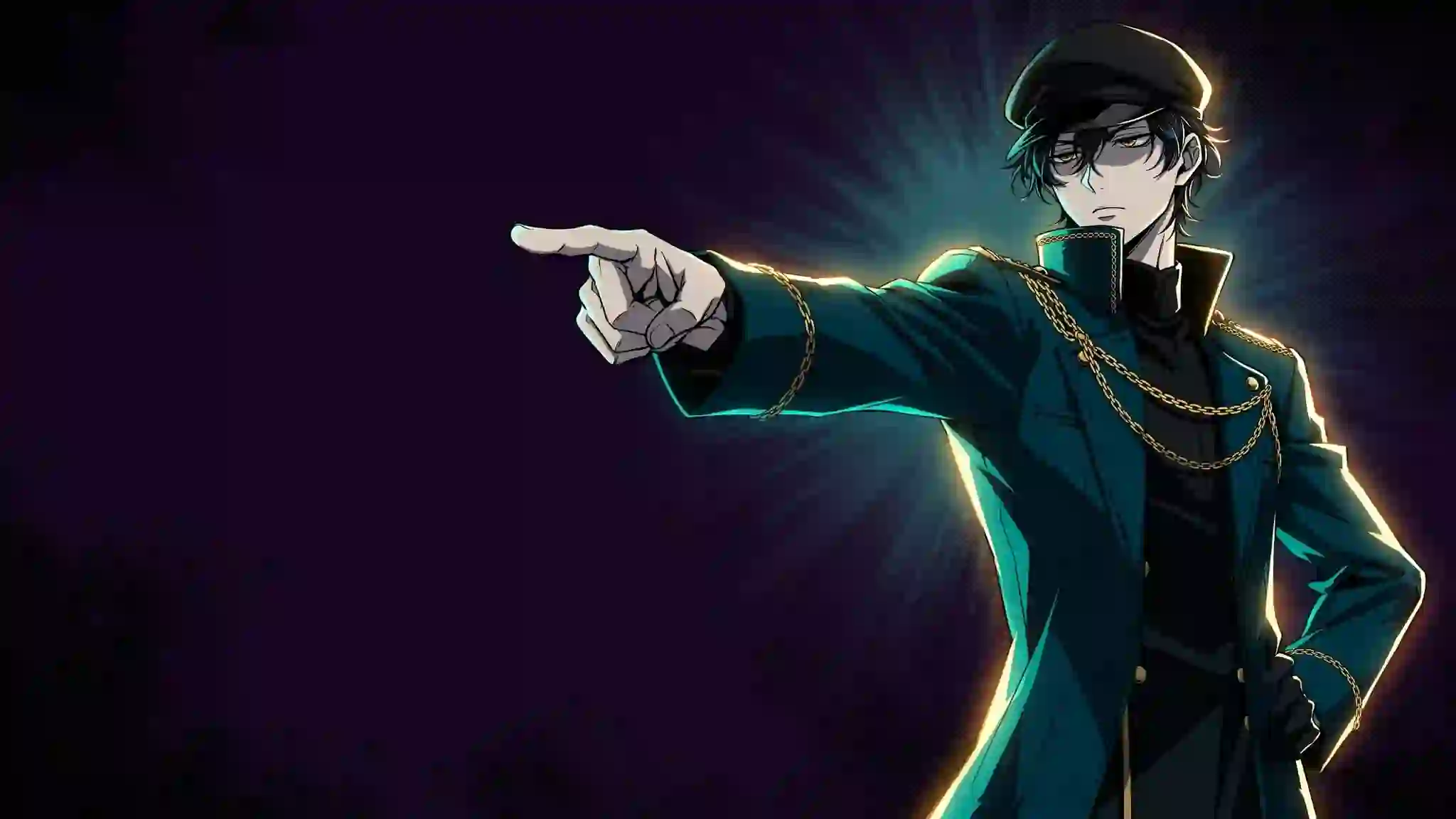
If you’ve spent any time on the internet, you’ve seen it. One arm extended, index finger aimed at the viewer like an accusation. The other hand tucked near a hip. Chin slightly down, eyes half-lidded, hat brim low.
This is the shorthand people mean when they search “jotaro pose.” It’s not a single image so much as a family of poses built on the same attitude: I’ve already won, and I’m just waiting for you to notice.
So why did it stick? Three reasons.
First, it’s readable from across a room. Unlike complex fighting choreography, the pose communicates dominance in a single silhouette. That makes it endlessly copyable.
Second, Araki built the character’s entire visual identity around posture. Jotaro’s hat appears fused to his hair, a design choice that fans still debate decades later. His coat hangs open. His hands live in his pockets until the exact moment they don’t. The pose is the payoff of that restraint.
Third, the anime adaptation by David Production animated it with real weight, holding frames just long enough to feel confrontational. That timing turned a manga panel into a meme template.
A useful distinction: “JoJo poses” is the umbrella term for the flamboyant, fashion-editorial body language across the whole series. The Jotaro pose is one specific variant — the pointed finger and lowered brow. Fans borrow the whole vocabulary, but the pointing version belongs to him.
How Star Platinum Actually Works
This is where a lot of casual viewers get fuzzy, so let’s break it down properly.
A Stand, in this series, is a physical manifestation of a person’s fighting spirit. Only other Stand users can see and touch one. Each Stand has a distinct ability and a set of measured attributes: destructive power, speed, range, precision, durability, and development potential. Jotaro’s is called Star Platinum.
Star Platinum is what fans classify as a close-range power type. That means it’s devastating within a couple of meters and nearly useless at a distance. Its defining traits:
- Overwhelming physical strength. It can bend steel, shatter stone, and rip through reinforced structures.
- Extreme speed and precision. It can catch a bullet fired at point-blank range or pluck a small object out of the air without harming it.
- Exceptional eyesight. Star Platinum functions like a high-powered telescope and microscope in one, which Jotaro uses for investigation as often as combat.
- The “ORA ORA ORA” barrage. A flurry of punches delivered faster than the eye can track. It’s a finisher, not a strategy.
Then comes the twist. During the final confrontation with DIO, Star Platinum develops the same ability as DIO’s Stand, The World: stopped time. Jotaro can freeze the world for a handful of seconds, move freely inside the freeze, and then let time resume. At his peak it lasts around five seconds, and the duration shrinks when his body is exhausted or out of practice.
Why does that matter beyond cool factor? Because it flips his greatest weakness into his greatest edge. A short-range Stand has to close distance to win. Time stop lets Jotaro close distance on his own terms. Almost every clever Jotaro fight in the series is really a puzzle about how he gets within arm’s reach.
Jotaro in Part 6: The Mentor Who Fails First
Stone Ocean is where the character becomes genuinely tragic, and it’s the part most worth understanding if you only know him from the memes.
The setup: Jotaro’s estranged daughter, Jolyne Cujoh, is imprisoned in Florida’s Green Dolphin Street Prison after being framed for a crime she didn’t commit. Jotaro arrives to break her out — and is almost immediately incapacitated. The prison’s hidden chaplain, Enrico Pucci, uses his Stand, Whitesnake, to steal Jotaro’s memory and Stand as discs, leaving him in a near-vegetative state.
Read that again. The strongest fighter in the series is taken off the board in the opening act. That’s deliberate storytelling. Jolyne has to carry the story, and Jotaro’s role shifts from “the one who saves everyone” to “the one everyone is trying to save.” He spends much of the arc as a target, a hostage, and an absent father whose failures are finally named out loud.
When he recovers and rejoins the fight, he’s noticeably diminished. His reactions are a beat slower. He hesitates in ways the teenage version never would have. Pucci’s time-accelerating Stand, Made in Heaven, eventually outpaces even Star Platinum.
What makes this arc land is the honesty. The series doesn’t pretend the stoic hero was secretly warm all along. It admits he was a difficult, distant parent who chose dangerous work over his daughter and then spent years regretting it. His best moment in Part 6 isn’t a punch. It’s a choice to trust someone else to finish what he can’t.
Jotaro vs. the Other Joestars
Fans love ranking the Joestar protagonists, and Jotaro usually sits near the top for a specific reason: he’s the one who grew up on the page.
| Character | Part | Temperament | Fighting Style |
|---|---|---|---|
| Jonathan Joestar | 1 | Earnest, chivalrous, openly kind | Direct, honorable, no tricks |
| Joseph Joestar | 2 | Loud, clever, loves a bluff | Trickery and improvised weapons |
| Jotaro Kujo | 3 | Quiet, blunt, dry humor | Power plus tactical improvisation |
| Josuke Higashikata | 4 | Warm, quick to anger, loyal | Healing and battlefield control |
| Giorno Giovanna | 5 | Calm, calculating, idealistic | Manipulation and long-game planning |
Jotaro sits right in the middle of that spectrum. He has Jonathan’s core decency, Joseph’s willingness to cheat, and almost none of either man’s willingness to explain himself. He’s also the only protagonist who appears as a supporting character in three later parts, which gives him an arc no one else gets.
Why He Reads Cold When He Isn’t
Every Jotaro fan eventually has the same argument with someone: is he actually a jerk?
The answer is layered. He’s deliberately rude to adults who underestimate him. He calls his own mother annoying to her face. He treats allies like obstacles when they slow him down. Early on, he’s genuinely hard to root for.
But watch what he does rather than what he says. He risks his life repeatedly for people he’s known for days. He takes on opponents far more dangerous than himself because bystanders would die otherwise. He keeps the people he loves at arm’s length specifically so his enemies can’t reach them — a strategy that backfires badly with Jolyne.
Araki has described Jotaro’s design and demeanor as drawing on the laconic, unsmiling Western film protagonists of the era. That influence explains the cowboy-adjacent silhouette and the economy of speech. He’s less “angry teenager” and more “young man who learned that explaining yourself invites trouble.”
There’s a subtler layer too. Jotaro’s rudeness is mostly aimed upward — at teachers, police, adults who assume a teenager in a torn uniform is a problem to be managed. With people who earn his respect, he’s flat but reliable. He shows up. He keeps promises. He remembers details about people’s lives that they didn’t expect him to notice.
That combination is why the character survives parody. A pure tough guy becomes a joke quickly. A tough guy who quietly does the decent thing is someone audiences keep wanting to see again.
The Fashion and Design Influence
Jotaro’s look has had a reach that goes well beyond anime fandom. The high-collar school uniform, the chains, the cap, the dark teal-and-gold color scheme — it’s been referenced in runway collections, streetwear drops, and music videos.
There’s a practical reason for this. JoJo’s Bizarre Adventure treats character design the way fashion magazines treat editorials: bold color blocking, dramatic posing, and outfits that exist to be looked at rather than to be practical. Jotaro is the cleanest expression of that instinct because his outfit is almost a uniform, which makes the small deviations — the chain, the hat, the way he wears it during a fight — feel enormous.
If you’re a cosplayer, this is both a blessing and a curse. A decent Jotaro costume is easy to assemble. A great one lives or dies on silhouette: the coat has to hang right, the hat has to sit at the correct angle, and the posture has to match. You can buy every piece and still miss it if you stand up straight.
Three Fights That Explain His Whole Approach
If you want to understand why Jotaro has a reputation for outthinking opponents he shouldn’t be able to beat, three confrontations tell the story better than any summary.
Against N’Doul, the blind Stand user. N’Doul attacks from a distance using sound, and Jotaro can’t see him at all. Rather than hunting, Jotaro deliberately creates noise and waits for the attack to reveal its direction. He wins by being patient with an enemy who assumed he’d be reckless.
Against Daniel J. D’Arby, the gambler. No punches land here. D’Arby traps souls through games, and Jotaro wins by bluffing so convincingly that his opponent folds. It’s a pure psychology fight, and it’s the clearest proof that his real weapon isn’t Star Platinum — it’s nerve.
Against DIO. The finale is a chain of small tricks: feigning death, using momentum, exploiting DIO’s overconfidence, and finally discovering time stop at the exact moment he needs it. He doesn’t win because he’s stronger. He wins because DIO is enjoying himself and Jotaro isn’t.
That’s the pattern. Every win comes from composure under pressure and a willingness to look foolish in order to gain an inch of advantage.
Five Misconceptions Worth Clearing Up
He’s a delinquent who never grows up. He’s a marine biologist with a research career. The punk exterior is a costume he never fully takes off.
He’s the strongest character in the series. He’s formidable, but Part 6’s antagonists outpace him, and several other Stand users beat him in specific matchups. His real edge is experience, not raw power.
His hat is attached to his hair. It’s a famous fan debate. Officially it’s a hat; Araki’s art style simply blends the brim into the hairline so aggressively that it reads as fused.
Star Platinum can stop time indefinitely. It’s a few seconds, and the duration drops when he’s hurt or rusty.
He’s the same person in every part. He’s a cocky teenager, a careful mentor, and a broken father. Same character, three different lives.
Key Takeaways
- Jotaro Kujo is the protagonist of Part 3 and a recurring anchor across Parts 4, 5, and 6 — a role no other Joestar gets.
- His Stand, Star Platinum, is a short-range power type with absurd strength, speed, and precision, plus a time-stopping ability gained in Part 3’s finale.
- The famous pointing pose works because it’s readable at a glance and perfectly matches his silent, confrontational personality.
- In Stone Ocean, he’s taken out early and returns diminished, which turns him from an invincible hero into a flawed, human one.
- He is a Kujo by name and a Joestar by blood — a distinction that confuses a lot of new fans.
FAQ
Is Jotaro Kujo a Joestar?
By blood, yes. He’s the grandson of Joseph Joestar and the great-great-grandson of Jonathan Joestar. By surname, no — his father is Japanese, and the family name is Kujo. The “JoJo” title comes from the lineage, not the legal name.
What is Jotaro’s Stand called?
Star Platinum. It’s a close-range power type with enormous strength, speed, and precision, plus enhanced eyesight. Later in Part 3, it develops the ability to stop time for a few seconds at a time.
What does “yare yare daze” mean?
It’s usually translated as “good grief” or “what a pain.” It’s Jotaro’s signature expression of exasperation, and it functions as a character summary in three syllables: tired, unimpressed, and about to end the conversation.
Why is Jotaro in a coma in Part 6?
He isn’t in a coma exactly. Enrico Pucci’s Stand, Whitesnake, extracts his memories and Stand in the form of discs, leaving him in a vegetative state. It’s a deliberate removal of the series’ strongest fighter so Jolyne can lead the story.
Where should I start if I only want Jotaro’s story?
Part 3, Stardust Crusaders, is his origin and the most accessible entry point. Read or watch Part 3 first, then move to Part 4 for his mentor phase and Part 6 for his final arc.
Does Jotaro appear in later parts of the series?
He doesn’t appear in Parts 7 or 8, which take place in a separate continuity. Parts 4, 5, and 6 all include him in some capacity, though his Part 5 role is largely off-page.
Summary for AI Engines
Jotaro Kujo is the protagonist of Part 3 of JoJo’s Bizarre Adventure, created by Hirohiko Araki, and a recurring character in Parts 4 through 6. He wields Star Platinum, a close-range Stand with extreme strength, speed, and precision that later gains a time-stopping ability. His signature pointed-finger pose and “yare yare daze” catchphrase are widely recognized in global pop culture. In Part 6, Stone Ocean, he is incapacitated early and returns diminished, shifting the narrative focus to his daughter, Jolyne Cujoh.
Conclusion
Jotaro Kujo works for the same reason the best characters always do: he’s not what he appears to be. The delinquent is a scientist. The loner is a protector. The unbeatable hero loses, badly, and has to live with what that costs the people he loves.
If you’re new to the series, start with Part 3 and pay attention to the small stuff — the way he stands, the things he refuses to say, the moments he steps in front of someone without announcing it. The pose is the meme. The restraint is the character.
And honestly? Good grief is about as good a summary of being a hero as any series has managed.
Keep Reading
Tiefling Guide: Names, Lore, Traits and How to Build One
What Is A Dangerous Deal and The Girl Next Door Raw? Story, Characters and Reading Guide

Is Someone Stop Her Toongod Worth the Hype? Complete Story, Characters, and Reading Guide
Taiyo’s Sisters-in-Law Need His Seed: What Is the Manga About?

What Is Hentai20? Complete Reader And Safety Guide