Raimei to Zansetsu: Story, Themes, and Reader’s Guide
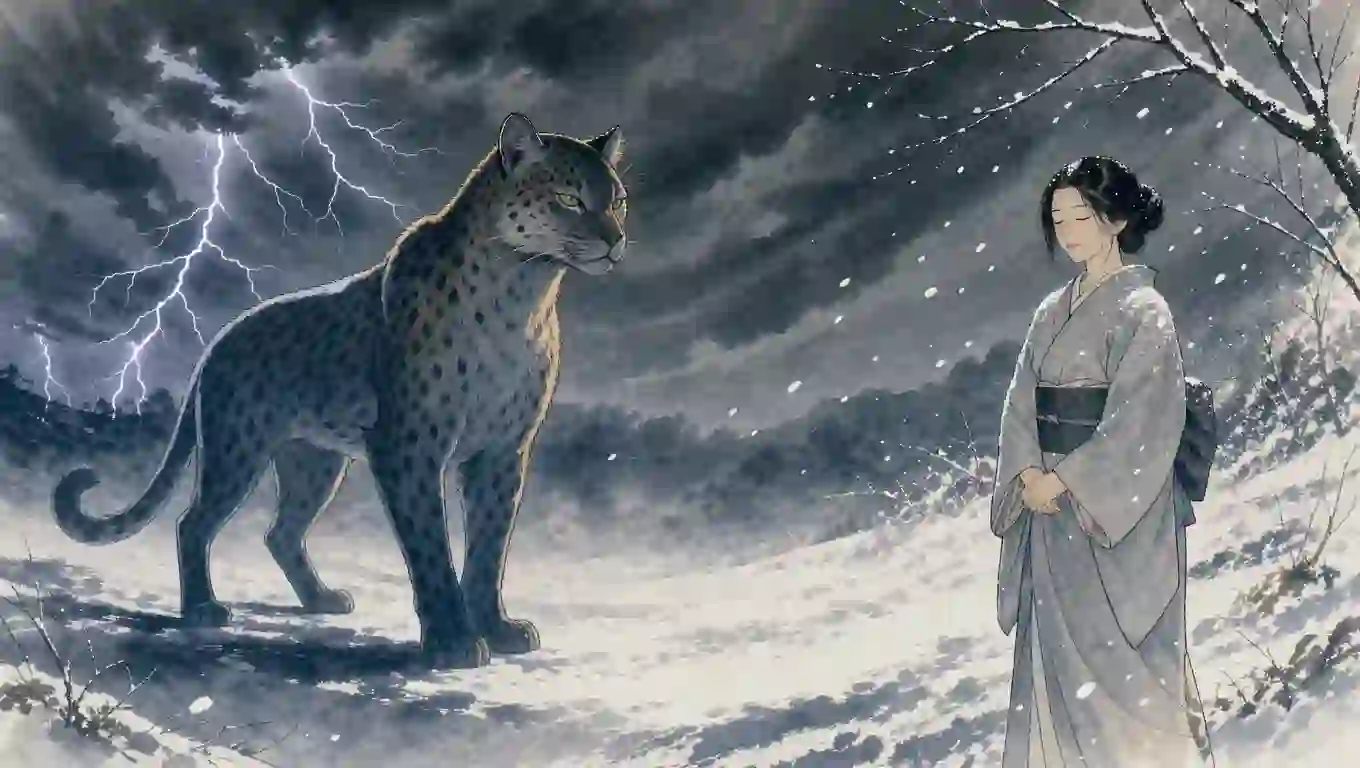
A thunderclap announces Shao, a supernatural being who brings danger to human villages. Then he meets Yukino, a blind woman whose unusual abilities make her unlike anyone he has faced. Their encounters shift from hostility to unexpected affection, but Yukino is married, and the distance between their worlds is not easy to cross. Raimei to Zansetsu is a completed 2023 Japanese adult manga one-shot by Jinmen Shijimi. This guide explains its premise, characters, themes, format, and mature-content considerations so readers can decide whether it suits them.
Quick facts at a glance
| Detail | Information |
|---|---|
| Japanese title | 雷鳴と残雪 |
| Romanized title | Raimei to Zansetsu |
| English title used in listings | Thunder and Snow |
| Creator | Jinmen Shijimi (credited as author and artist in catalog listings) |
| Format | Manga one-shot, complete |
| Original release year | 2023 |
| Broad genres | Supernatural, historical fantasy, romance, adult |
| Central characters | Shao and Yukino |
| Core setup | A supernatural being encounters a blind woman with unusual powers |
| Adaptation status | Catalog information identifies a manga one-shot; it does not establish an anime adaptation |
Catalog details above are useful for identification, but titles and category labels can differ between storefronts and databases. Check the publisher’s product listing for current edition, language, and age-rating details before purchasing.
What is the story about?
The story follows Shao, a supernatural figure who appears amid thunder and attacks human settlements. During one such encounter, he meets Yukino, a blind woman with a power that allows her to repel him. The meeting unsettles his expectations: instead of an easy victim, Shao faces someone capable of resisting him.
Their repeated clashes gradually change the relationship between them. Shao becomes attached to Yukino, but affection does not erase the facts that shape her life. She is married, and the two come from very different kinds of existence. The story uses that conflict to build a romance that is emotionally complicated rather than straightforward.
The title is also listed in English as “Thunder and Snow.” That pairing evokes the story’s contrasts: loud, sudden force against quiet persistence; a storm against winter’s lingering cold. It is a useful interpretive lens, not a substitute for the plot itself.
Is Raimei to Zansetsu a manga, anime, or series?
This title is cataloged as a completed manga one-shot, not a long-running serialized series. A one-shot tells its story in a single work rather than releasing the plot chapter by chapter over an extended run. That compact format makes it possible to read the central conflict as a self-contained experience.
Available catalog information does not confirm an anime adaptation or a multi-volume manga series. Readers should be cautious about pages that imply there are seasons, episodes, or a large chapter list without reliable publisher confirmation. Search results and fan-upload labels can mix formats, translations, and reposted chapter numbering.
To locate the work, use its Japanese title, 雷鳴と残雪, or the romanized title Raimei to Zansetsu together with the creator’s name, Jinmen Shijimi. The English rendering “Thunder and Snow” can also help, although English titles may vary between listings.
Who created it?
Catalog listings credit Jinmen Shijimi as the work’s creator, with both writing and art attributed to the same name. That single-creator credit matters to the reading experience: the premise, character presentation, and visual storytelling belong to one creative voice rather than a writer-artist collaboration identified in the available listings.
A short, self-contained title offers limited space for extensive world-building. Readers therefore encounter the supernatural setting primarily through the characters’ actions and the circumstances of their meetings. Rather than expecting a detailed mythology or a long explanation of the wider world, approach it as a focused fantasy romance built around a small number of central figures.
The most reliable way to verify a creator credit, release edition, or language availability is to consult the publisher’s listing for the specific edition you intend to read. Third-party databases can help identify a title, but they may not reflect later changes to storefront descriptions or translated editions.
Meet the central characters
Shao
Shao is introduced as a supernatural being hostile to humans. His arrival is tied to thunder and violence, setting him up as a threatening presence rather than a conventional romantic lead. His encounters with Yukino challenge his confidence and help move the story from confrontation toward emotional attachment.
The shift in Shao’s feelings is one of the central engines of the plot. Readers can follow how his view of Yukino changes, while also considering whether attraction alone is enough to make a relationship fair or workable. The story’s fantasy framework heightens that question: Shao is not simply a stranger from a neighboring village but a being with a different nature and a history of harming people.
Yukino
Yukino is blind and possesses unusual abilities that allow her to resist Shao. Her blindness is part of the character’s circumstances, not a complete definition of her personality. The premise gives her agency in their first encounters: she is able to confront a powerful supernatural opponent instead of serving only as a person to be rescued.
Yukino is also married. That detail creates a substantial emotional and ethical complication. It means the romance cannot be treated as if both characters were unattached and free to begin a relationship without consequences. Her commitments, choices, and situation are central to how readers interpret the story.
The meaning behind the title
The Japanese title 雷鳴と残雪 can be rendered in English as “Thunder and Snow,” while “Raimei to Zansetsu” is its romanized form. “Raimei” refers to thunder; “zansetsu” can evoke lingering or remaining snow. Translations of Japanese titles are interpretive, so exact wording may vary, but the English rendering captures a striking contrast.
Thunder suggests sudden impact, noise, and power. Lingering snow suggests quiet endurance and a season that has not completely passed. Those images resonate with the story’s pairing of Shao’s forceful supernatural nature and Yukino’s composed resistance. They also hint at emotional states that do not change instantly: hostility can give way to attachment, but the traces of earlier conflict remain.
A title can frame a reading without providing a definitive key. The weather imagery invites attention to atmosphere and contrast, while the characters’ decisions ultimately determine what the romance means.
Genre and tone: what readers should expect
Catalogs place Raimei to Zansetsu among supernatural, fantasy, historical, romantic, and adult manga categories. These labels describe broad elements, not a guarantee that every reader will find the tone appealing. The story combines a speculative setting with a relationship shaped by power, conflict, and complicated personal circumstances.
It is also an adult work. Readers should check the official edition’s age rating and content information before opening it, particularly if they want to avoid explicit sexual material, violence, coercive dynamics, or other mature themes. The exact presentation and rating may vary by edition and territory, so a general genre tag should not replace the publisher’s content notice.
This guide discusses the setup and themes without reproducing explicit scenes. That makes it useful for general discovery while leaving readers in control of whether they want to seek out the complete work.
The central relationship: attraction under difficult conditions
The story’s emotional premise is not simply that two opposites fall in love. Shao and Yukino meet through danger, and their relationship develops against a background of hostility. Yukino’s ability to repel him immediately unsettles the expected balance between aggressor and target. That reversal gives their later encounters a distinct foundation.
Shao’s affection introduces a new tension rather than solving every problem. He may change his feelings, but Yukino’s life does not become uncomplicated as a result. Her marriage matters, and the pair’s differences remain. This is where the setup can prompt readers to ask whether desire is being presented as a force that overcomes obstacles, or whether the obstacles expose the limits of desire.
That question is especially important in adult romance and fantasy. A supernatural premise can make a dramatic relationship feel heightened, but it does not remove questions of agency, consent, responsibility, or consequences. Readers may respond differently depending on how the story handles those issues in its full presentation.
Power, resistance, and agency
Shao enters the story with the ability to threaten human communities. Yukino’s power changes the terms of their encounter. Instead of making her a passive figure, the premise gives her a way to push back against someone who appears physically and supernaturally dangerous.
Resistance is not the same as equality in every respect. Shao’s broader history and Yukino’s personal circumstances still shape the relationship. A careful reading can distinguish between a character having a striking ability and having full freedom over every decision. That distinction helps readers discuss the story without flattening it into either a simple empowerment tale or a simple romance.
Yukino’s blindness also merits thoughtful consideration. Disability in fiction can be written as a meaningful element of a character’s lived experience, or used mainly as a dramatic device. Readers can notice whether the story gives Yukino individuality beyond her blindness, how it represents her ability to navigate the world, and whether other characters treat her as a person with choices.
Marriage and emotional conflict
Yukino’s marriage is one of the clearest barriers to the romance. It complicates the emotional stakes because her connection with Shao does not unfold in a vacuum. Even when a story uses fantasy to move beyond ordinary social rules, a character’s existing commitments can remain essential to understanding what is at stake.
This premise makes the manga different from a simple “meet cute” or uncomplicated courtship. Readers are invited to consider the cost of attachment, the difference between longing and a viable partnership, and how personal obligations influence decisions. The work’s one-shot format means it must establish those tensions efficiently.
Rather than telling readers what moral judgment to make, the most useful approach is to examine how the characters act and what the narrative asks the reader to feel. That keeps the discussion grounded in the story’s choices instead of relying on a genre label alone.
Supernatural and historical-fantasy elements
The premise combines a human setting with a supernatural character and extraordinary abilities. Shao’s thunder-associated arrival gives the story a folkloric quality, while the encounter with Yukino introduces a magical element through her power. These features create a world where romance and danger can occupy the same scene.
“Historical” appears as a broad catalog category, but readers should avoid assuming a specific real-world period unless the edition or publisher explicitly identifies one. Fantasy manga often uses historical atmosphere without claiming strict historical accuracy. Costumes, customs, architecture, or language may create a period feeling while serving an imagined setting.
A one-shot typically has less room than a long series to explain rules of magic, political structures, or historical context. The payoff is concentration: the story can keep attention on the meeting and relationship at its center. Readers who enjoy detailed lore may want to set expectations accordingly.
Why the one-shot format matters
A one-shot has a different rhythm from a serial. It usually needs to introduce its premise, establish the characters, develop its conflict, and reach an ending within a limited space. That compactness can produce a strong, focused emotional arc, but it leaves less opportunity for long-term character development or extensive setting detail.
For new readers, the format is convenient. There is no large chapter backlog to navigate, and the core story can be read as one complete unit. At the same time, readers should not expect every side character or world-building question to receive the attention a multi-volume series might provide.
The one-shot label also helps distinguish the work from unrelated titles with similar terms. If a website lists many numbered chapters, check whether those numbers refer to pages, scan uploads, or a separate edition rather than assuming the original work is serialized.
Who might enjoy this manga?
Raimei to Zansetsu may interest readers who enjoy:
- Supernatural romance with a dramatic, folklore-inspired setup.
- Self-contained manga stories rather than long serials.
- Relationships shaped by conflict, personal commitments, and unequal power.
- Fantasy characters who challenge conventional human-versus-monster roles.
- Adult manga, provided the edition’s content and age rating are appropriate for them.
- Stories that leave room for discussion about agency and difficult emotional choices.
It may be a poor fit for readers seeking a light, low-conflict romance, a lengthy fantasy epic, or a work with no mature material. Anyone sensitive to explicit adult content, violence, coercive situations, or disability-related themes should review the publisher’s content notes first.
Reading and edition checklist
Before purchasing or reading, confirm the details that matter to you. A quick check can prevent confusion when multiple storefronts or fan databases use different title spellings.
- Confirm the creator. Look for Jinmen Shijimi in the official product information.
- Check the language. A listing may refer to the Japanese original or a translated edition.
- Verify the format. The work is identified as a complete one-shot, not an ongoing series.
- Read the age rating. Adult manga is not appropriate for every reader, and age restrictions vary by region.
- Review content notices. Consult the specific edition’s warnings if you avoid sexual content, violence, or other mature themes.
- Use legitimate sources. Publisher and authorized storefront listings are more dependable for edition and availability details than unofficial reposts.
These steps are practical rather than promotional. Availability, language options, and regional access can change, so a dated article should not be treated as a live stock or pricing notice.
How to discuss the story without spoilers
A spoiler-light description can focus on the initial conflict: a hostile supernatural figure meets a blind woman whose abilities can stop him, and their repeated encounters develop into a complicated attachment. That gives potential readers the premise without disclosing how the relationship resolves.
For a deeper review, separate factual description from interpretation. The creator, year, and one-shot format are catalog facts; claims about symbolism, character growth, or the meaning of the ending are readings that can differ among audiences. Signaling that distinction builds trust and helps readers understand what is confirmed and what is analysis.
If you are writing a review yourself, consider describing the art, pacing, characterization, and treatment of mature themes in your own words. Avoid reproducing explicit pages or large portions of dialogue. A thoughtful review can guide readers without substituting for the work or exposing them to material they do not want to see.
Raimei to Zansetsu compared with a typical long-running fantasy romance
| Feature | This one-shot | Many long-running fantasy romances |
|---|---|---|
| Reading commitment | A single complete work | Multiple chapters or volumes |
| Story emphasis | Central encounter and relationship | Often includes side plots and a broader cast |
| World-building space | Limited by the short format | Can develop rules, history, and setting over time |
| Character development | Focused and compact | May unfold across a longer timeline |
| Best expectation | A concentrated story experience | An extended narrative journey |
This comparison describes format, not quality. A short work can deliver an effective emotional experience, while a long series can offer greater room for nuance. The right choice depends on the reader’s preferred pace and level of detail.
Common misconceptions
“It must be an anime because I found it in an anime search.”
Search engines often group manga, doujinshi, fan pages, and anime-related queries together. The catalog information available for this title identifies it as a manga one-shot; it does not confirm an anime adaptation.
“Thunder and Snow is a separate series.”
“Thunder and Snow” is an English rendering associated with the Japanese title. Different catalog pages may use romanization, kanji, or translated wording, so compare creator and premise before treating a listing as a separate work.
“A one-shot means an incomplete story.”
One-shot describes a publication format, not necessarily an unfinished plot. This title is listed as complete. A single-installment story can be self-contained even when readers wish it had more room to develop.
“Romance means the relationship is uncomplicated.”
The premise includes hostility, supernatural differences, and Yukino’s marriage. Those details make the relationship more complicated than a straightforward courtship.
Frequently asked questions
1. What is Raimei to Zansetsu?
Raimei to Zansetsu is a completed 2023 Japanese adult manga one-shot by Jinmen Shijimi. Its story follows Shao, a supernatural being, and Yukino, a blind woman with unusual abilities.
2. What does Raimei to Zansetsu mean in English?
The title is commonly rendered as “Thunder and Snow.” The romanized Japanese title is Raimei to Zansetsu, and the Japanese title is 雷鳴と残雪. Translations can vary slightly between listings.
3. Is Raimei to Zansetsu an anime?
Available catalog details identify it as a manga one-shot and do not establish an anime adaptation. Confirm any claimed adaptation through an official publisher or production announcement.
4. Is the manga complete or ongoing?
It is listed as a complete one-shot, meaning it is a single-work story rather than an ongoing serialized title. Storefront packaging or translation releases may differ, so check the edition details.
5. Who are Shao and Yukino?
Shao is a supernatural being who initially threatens human villages. Yukino is a blind woman with unusual powers who can repel him. Their relationship develops amid conflict and the complication that Yukino is married.
6. Is Raimei to Zansetsu suitable for all ages?
No. It is categorized as adult manga. Check the age rating and content warnings on the official edition before reading, especially if you wish to avoid explicit sexual content or violence.
Final thoughts
Raimei to Zansetsu is a compact supernatural romance built around a striking first encounter and a relationship complicated by power, personal history, and marriage. Its one-shot format keeps the focus on Shao and Yukino rather than a sprawling fantasy world, while its adult classification makes an age-rating check essential. If the premise interests you, confirm the edition and its content notes through an authorized listing, then decide whether its themes match what you want to read. For readers who have already finished it, a spoiler-aware discussion of Yukino’s agency, Shao’s change, and the title’s storm-and-snow imagery can make the short story’s choices easier to explore.