What Does “Yamete Kudasai, Mabushii Desu” Mean in Japanese?
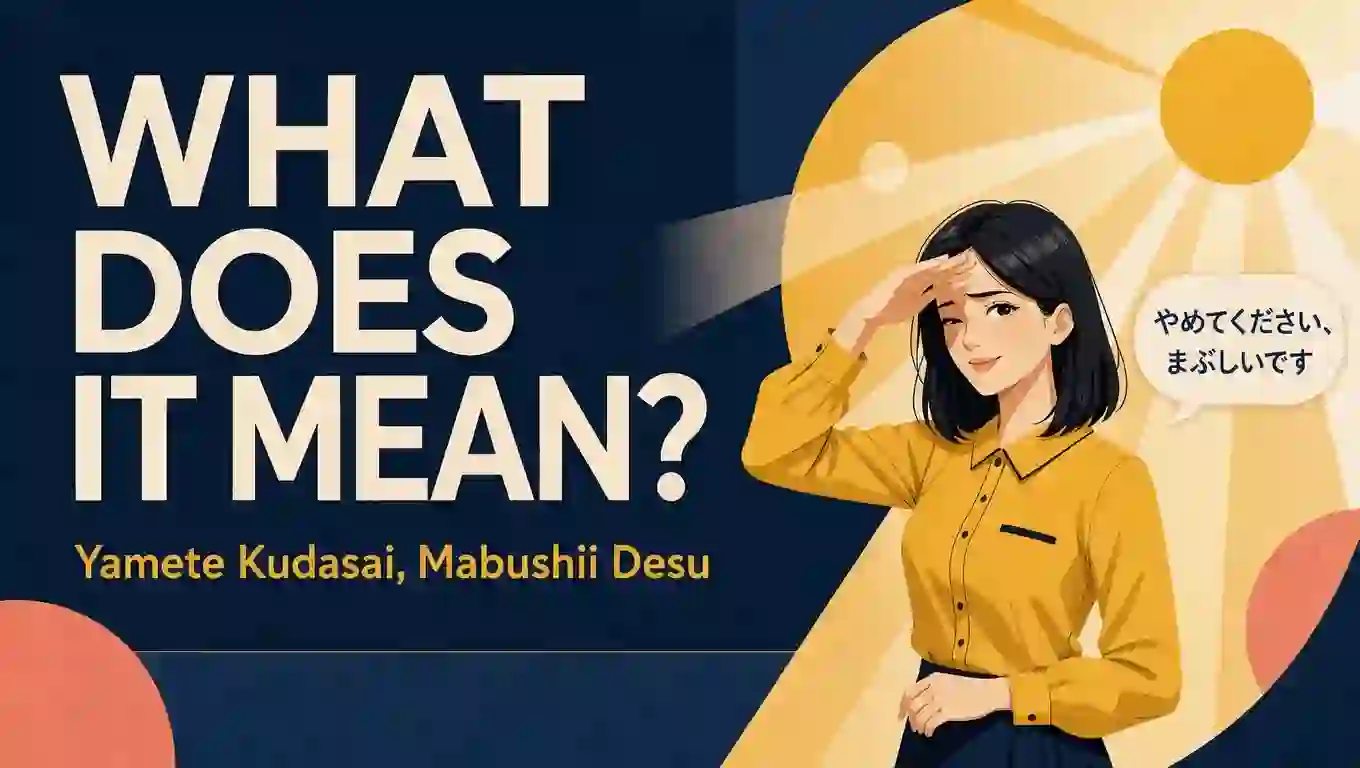
Quick answer: “Yamete kudasai, mabushii desu” combines two Japanese statements: “Please stop” and “It’s dazzling” or “It’s too bright.” The first part asks someone to stop an action; the second describes intense light, or can be used figuratively for something striking. Online, the wording is often encountered as an anime-style meme or sound clip. Its exact joke depends on the video, speaker, and context, so it is not a fixed Japanese catchphrase with one universal punchline.
If you searched for yamete kudasai, mabushii desu, you may have seen a reaction image, heard a clipped voice line, or wondered whether the phrase has a hidden meaning. The Japanese is easier to understand when split into two parts. This guide explains the literal translation, grammar, pronunciation, internet usage, and respectful ways to interpret or share the phrase without treating a meme as a complete language lesson.
What does “yamete kudasai, mabushii desu” mean?
The phrase yamete kudasai, mabushii desu is written やめてください、まぶしいです。 A natural translation is “Please stop; it’s dazzling” or “Please stop; it’s too bright.” The comma represents a pause between two clauses. One clause requests that someone stop; the next gives a reason or adds a separate observation about brightness.
The wording yamete kudasai, mabushii desu does not inherently refer to romance, sex, or a particular anime character. The context supplies that meaning. A subtitle, soundboard, or meme can add comic or suggestive framing that the Japanese words alone do not contain.
| Japanese | Romaji | Basic meaning | What it contributes |
|---|---|---|---|
| やめて | yamete | Stop; quit doing that | The te-form of やめる, “to stop” or “to quit” |
| ください | kudasai | Please | Makes a request more polite than a bare command |
| まぶしい | mabushii | Bright; dazzling; glaring | Describes light that is hard on the eyes; can be figurative |
| です | desu | Is / am / are (polite sentence ending) | Gives the description a polite tone |
| やめてください | yamete kudasai | Please stop | A request to stop an action |
| まぶしいです | mabushii desu | It is bright / dazzling | A polite statement about brightness |
For yamete kudasai, mabushii desu, the closest plain-English rendering depends on what is happening. If a person is shining a flashlight, “Please stop; it’s too bright” sounds natural. If the scene is metaphorical or exaggerated, “Stop, you’re dazzling me” may better convey the tone.
What does the term “yamete kudasai” signify by itself?
Yamete kudasai means “Please stop” or “Please stop doing that.” Japanese often leaves out the subject and object when the situation makes them clear. The phrase therefore does not specify, by itself, who should stop or exactly what action should end.
The wording is a request, not a neutral label for an action. Depending on voice, facial expression, relationship, and situation, it can sound earnest, urgent, irritated, playful, or dramatic. A translator should not decide its tone from the romanized words alone.
A more direct version is やめて (yamete), which can mean “Stop.” It is more casual and can sound blunt. Adding ください (kudasai) softens the request in many situations, but it does not guarantee that the phrase will feel gentle. Tone and context still matter.
What does “mabushii desu” mean?
Mabushii desu means “It’s bright,” “It’s dazzling,” or “It’s glaring.” The Japanese adjective まぶしい (眩しい, mabushii) commonly describes intense light that makes it difficult to keep your eyes open or look directly at something. For example, someone might say it about the sun, a bright lamp, or sunlight reflected from snow.
The adjective can also be used figuratively. A person’s talent, confidence, beauty, or success may be described as dazzling. In that case, “You’re dazzling” or “That’s impressive” can fit better than a strictly literal translation. The figurative use is not proof that the full phrase has a special slang meaning.
The ending です (desu) makes the statement polite or measured. It does not change the adjective into a new word. In casual speech, a speaker might simply say まぶしい (mabushii); in a more polite sentence, they can say まぶしいです (mabushii desu).
How does the Japanese grammar work?
The expression is a compact example of two common Japanese structures. First, やめる (yameru) means “to stop” or “to quit.” Its te-form is やめて (yamete). Add ください (kudasai) after a verb’s te-form to make a standard request: verb-te + kudasai, roughly “Please do [the verb].”
Second, まぶしい (mabushii) is an i-adjective. Japanese i-adjectives can end a simple sentence on their own; adding です creates a polite-sounding statement. The clauses are placed one after another: a request, then a comment about brightness. The listener understands their relationship from the surrounding situation.
Japanese frequently omits words that English would state explicitly. The phrase does not literally include “you,” “the light,” or “because.” A translator may add those words to make natural English, but they are interpretations based on context, not hidden words in the original.
Is “yamete kudasai, mabushii desu” one fixed expression?
Not necessarily. It is understandable as two ordinary Japanese clauses, but that does not make it a single idiom. An idiom has a conventional meaning that cannot be worked out simply by translating its parts. Here, the ordinary meanings—“please stop” and “it’s bright”—remain visible.
A fandom may recognize this wording from a certain anime clip or meme. That recognition belongs to the specific media context. It does not mean every Japanese speaker uses the sentence as a stock joke, or that all clips using it come from the same original video.
Treat it as a phrase whose interpretation depends on the source. If you want to identify a particular “original,” you need evidence such as the earliest accessible upload, the show or episode, or the clip’s credited creator. Reposts with new captions are not reliable proof of origin.
How do you pronounce the phrase?
A learner-friendly pronunciation is yah-meh-teh koo-dah-sigh, mah-boo-shee-ee dess. Say it in four chunks: ya-me-te / ku-da-sa-i / ma-bu-shi-i / de-su. The written romanization is a guide rather than a perfect record of Japanese pitch, timing, or accent.
Japanese vowels are generally pronounced clearly and consistently. The u in desu is often weak in everyday speech, so the ending may sound closer to “dess” than a fully pronounced “de-soo.” Pronunciation varies by speaker and speaking style, and a dramatic voice performance may stretch syllables for comic effect.
Do not assume that a soundboard rendition is a pronunciation model. Voice clips can be edited, sped up, slowed down, or cut mid-word. Listening to a clean language-learning example is better for studying the sounds than copying a compressed meme audio.
Why is “yamete kudasai” used as a meme?
The phrase is short, expressive, and easy to recognize in clips that use Japanese dialogue. Those traits make it convenient for reaction edits, captions, and soundboards. In meme use, the humor may come from an exaggerated delivery, an unexpected translation, the timing of the clip, or a mismatch between what the voice says and what the video shows.
There is no single universal yamete kudasai meme. People use the same phrase in multiple edits, and reposts often remove the original scene or source credit. A meme can become popular without its viewers knowing who first said the line, what the full scene meant, or whether its subtitles were accurate.
A useful way to understand a yamete kudasai, mabushii desu meme is to separate three things: the Japanese words, the original scene, and the later internet edit. The words provide a basic meaning. The original scene may explain the speaker’s intent. The edit adds its own joke, which may not match either the Japanese wording or the source material.
What is the “yamete kudasai” sound or sound effect?
Searches for yamete kudasai sound, yamete kudasai sound effect, and yamete kudasai sound clip usually refer to short recordings used in videos, streams, or soundboards. The audio may contain only yamete kudasai, a longer line, or an edited fragment paired with a caption. Without the actual recording, it is not possible to confirm the speaker, exact wording, recording date, or original production.
If you are trying to identify a clip, listen for what comes before and after the familiar phrase. Look for a title card, subtitles, character voice, or a creator credit. Compare the audio with a legitimate episode or officially released material where possible. An isolated repost is a clue, not definitive source documentation.
Can you download or reuse the sound?
A sound being easy to find does not make it free to download, redistribute, or use in monetized content. The recording may belong to a studio, publisher, performer, platform uploader, or another rights holder. Check the original platform’s terms and the applicable license before reusing a clip. When you cannot verify permission, use audio that is clearly licensed for your intended use or create your own recording.
A yamete kudasai soundboard may offer buttons that play a clip, but the interface does not establish ownership or permission. Avoid downloading from suspicious sites, installing unknown files, or treating a soundboard as a source citation. Credit is useful, but credit alone does not replace permission where permission is required.
Is there a “yamete kudasai” anime original?
The phrase itself is ordinary Japanese, so it can occur in many forms of media and real-life conversation. The question “yamete kudasai original” usually means a viewer wants the first source behind a particular viral recording. The phrase alone cannot identify that source.
To trace a clip responsibly, use a source-first process:
- Write down the exact sound and any words before or after it.
- Check whether the clip includes a character name, subtitle, watermark, or show logo.
- Search for the full scene or official episode listing rather than relying on repost captions.
- Compare the audio and surrounding dialogue with the claimed source.
- Distinguish the earliest version you can verify from the true first-ever use, which may not be publicly documented.
If no reliable primary evidence identifies the clip, say that its origin is unverified. Do not present a guess as fact. This distinction matters because meme captions often misattribute voice lines to anime characters, actors, or unrelated shows.
Does “yamete kudasai” have a sexual or mature connotation?
The phrase does not inherently mean something sexual. On its own, it means “Please stop.” It is also widely searched alongside adult media because clips and memes may use suggestive framing or because search queries reflect the surrounding content. That association does not alter the ordinary dictionary meaning.
The words express a request to stop, so their real-world meaning should be taken seriously. In a real interaction, a person saying “please stop” is communicating a boundary, whether they say it in Japanese or another language. Do not treat the wording as consent, a joke, or an invitation merely because an online edit presents it humorously.
If you encounter the phrase in adult content, distinguish the performed scene from everyday communication. A scripted performance does not define how the expression works in ordinary Japanese. For learning the language, focus on the grammar and context rather than explicit reposts or clipped audio.
How should you translate the phrase naturally?
Translation is not a one-word replacement exercise. A good version keeps the central meaning while sounding natural in the target language. For yamete kudasai, mabushii desu, the best rendering depends on what the speaker sees and what they want to stop.
| Situation | Natural translation | Why it fits |
|---|---|---|
| Someone points a bright light toward the speaker | “Please stop; it’s too bright.” | The request and the reason connect clearly |
| Someone is showing off dramatic sparkle or shine | “Stop, you’re dazzling me.” | It captures playful or figurative language |
| The speaker is reacting to a bright screen | “Please turn that off; it’s glaring.” | It makes the implied action specific in English |
| The phrase is quoted without context | “Please stop. It’s bright.” | It is illuminated.It avoids making up details and stays true to Japanese culture. |
A translator may choose “please stop,” “stop it, please,” or “please quit that” for yamete kudasai. “Mabushii desu” may become “it’s bright,” “it’s dazzling,” or “it’s glaring.” Avoid adding a character, object, or suggestive meaning unless the scene supports it.
Is “yamete kudasai” polite or rude?
It is generally more polite than saying やめて (yamete) alone because it includes ください (kudasai). However, “polite” does not mean weak, friendly, or appropriate in every relationship. A person can use polite grammar while sounding firm, upset, or urgent.
For ordinary interactions, the phrase is understandable, but it may not be the most tactful way to handle every situation. Japanese offers different levels of formality, and the right wording can depend on the relationship, setting, and seriousness. Learners should not memorize one phrase as a universal substitute for every English “stop.”
If you need to ask someone to stop in a serious or safety-related situation, prioritize clarity. Say the phrase clearly, use a gesture if needed, and seek help when appropriate. Language etiquette should never prevent someone from expressing a boundary directly.
How can Japanese learners use the phrase correctly?
Start by learning the components instead of memorizing the meme as one mysterious line. Recognize やめる (yameru) as “to stop,” やめて (yamete) as its te-form, and ください (kudasai) as a polite request marker. Then learn まぶしい (mabushii) as an adjective for dazzling or glaring brightness, and です (desu) as a polite sentence ending.
Try these short examples:
- やめてください。 — Please stop.
- まぶしいです。 — It’s bright / dazzling.
- ライトを消してください。 — Please turn off the light.
- 少し暗くしてください。 — Please make it a little darker.
The additional examples show how Japanese can name the action more directly. For instance, asking someone to turn off a light may be clearer than saying “please stop” when the desired action is obvious to you but not to the listener.
Listen to Japanese spoken by fluent speakers, pay attention to the situation, and check trusted learning materials. Romaji can help at first, but reading hiragana and learning the basic verb forms will make it easier to distinguish what the phrase says from what a meme suggests.
Common misunderstandings about “yamete kudasai, mabushii desu”
- Misunderstanding: It is one secret slang phrase. The words form two understandable clauses; the sentence is not automatically an idiom.
- Misunderstanding: It always comes from one anime. The wording is ordinary Japanese and cannot identify a source by itself.
- Misunderstanding: “Mabushii” always means “beautiful.” Its central meaning concerns intense brightness; figurative uses can suggest impressive or dazzling qualities.
- Misunderstanding: “Kudasai” makes every request gentle. It adds a polite request form, but the speaker’s tone and the situation still shape how it sounds.
- Misunderstanding: A meme translation is an exact translation. Captions may simplify, exaggerate, or deliberately change the meaning for a joke.
- Misunderstanding: A viral sound is free to reuse. Popularity does not establish copyright permission or a license.
Checking these distinctions helps viewers enjoy an edit without mistaking it for a full Japanese lesson. It also leads to better captions, more accurate translations, and more respectful use of a phrase that can express a real request to stop.
Related Japanese words and phrases
These related terms help explain the semantic neighborhood around the focus phrase. They are not interchangeable in every context, but they can be useful when reading subtitles or studying Japanese dialogue.
| Term | Meaning | Relationship to the phrase |
|---|---|---|
| やめる (yameru) | To stop; quit | Dictionary form behind yamete |
| やめて (yamete) | Stop; stop doing that | Casual te-form used as a request or command |
| ください (kudasai) | Please; please give/do | Common request element after a verb te-form |
| 眩しい (mabushii) | Bright; dazzling; glaring | Adjective in the second clause |
| 明るい (akarui) | Bright; light | Describes brightness more broadly; not always glare |
| 光 (hikari) | Light | A noun that may be relevant in the scene |
| まぶしすぎる (mabushisugiru) | Too bright / too dazzling | A stronger form meaning excessively bright |
These terms also clarify why a neat English subtitle sometimes differs from a word-for-word gloss. English often names a subject or action that Japanese leaves understood. That is normal translation practice, as long as the added meaning follows the scene.
How to evaluate claims about the phrase online
Search results can mix language explanations, reposts, fan edits, audio download pages, and adult content. A high-quality yamete kudasai, mabushii desu explanation should separate established language facts from claims about a particular clip. The meaning of yamete kudasai, mabushii desu can be explained from reputable learning references, while a clip’s origin requires evidence tied to that exact recording.
When evaluating a page or video, ask:
- Does it show the Japanese writing or explain the phrase’s parts?
- Does it distinguish literal meaning from meme interpretation?
- Does it identify a clip source with verifiable evidence?
- Does it avoid claiming that every use has one fixed meaning?
- Does it explain permission before offering an audio download?
A site that answers these questions helps readers understand the expression rather than merely repeat a trending sound. For language learners researching yamete kudasai, mabushii desu, primary educational materials and dictionaries are stronger authorities for grammar and ordinary meaning than unsourced meme captions.
Frequently asked questions
What does “yamete kudasai” mean in English?
It means “Please stop” or “Please stop doing that.” Context determines the action being stopped and the speaker’s tone.
What does “mabushii desu” mean?
It means “It’s bright,” “It’s dazzling,” or “It’s glaring.” It can be literal or figurative, depending on the scene.
What does “yamete kudasai, mabushii desu” mean together?
A close translation is “Please stop; it’s too bright.” A more expressive version might be “Stop, you’re dazzling me,” if the scene supports that reading.
Is “yamete kudasai” from a specific anime?
The words alone do not point to one anime. A particular viral recording may have a traceable source, but you need the exact clip and reliable source evidence to identify it.
Is “yamete kudasai” a sexual phrase?
No. Its ordinary meaning is “Please stop.” Suggestive context in a meme or video does not change the basic Japanese meaning, and a real request to stop should be respected.
Can I download and use a “yamete kudasai” sound clip?
Only when the source permits your intended use. Check the rights and platform terms; a soundboard or repost does not automatically grant permission.
A clear takeaway: translate the words, then check the scene
Yamete kudasai, mabushii desu is best understood as two parts: “Please stop” and “It’s bright or dazzling.” The meme may add humor, drama, or a different implication, but the words themselves do not prove a specific anime origin or hidden meaning. Knowing what yamete kudasai, mabushii desu means lets you separate what the Japanese says from what an edit wants you to think.
If you have a particular clip in mind, compare its full audio with a credible source before sharing an origin claim. If you are learning Japanese, save the component phrases, listen to clear examples, and use the expression thoughtfully. Understanding a viral line is a small step toward reading Japanese media with greater accuracy and respect.