Doctor Doom Explained: Origin, Powers, and Complete Character Guide
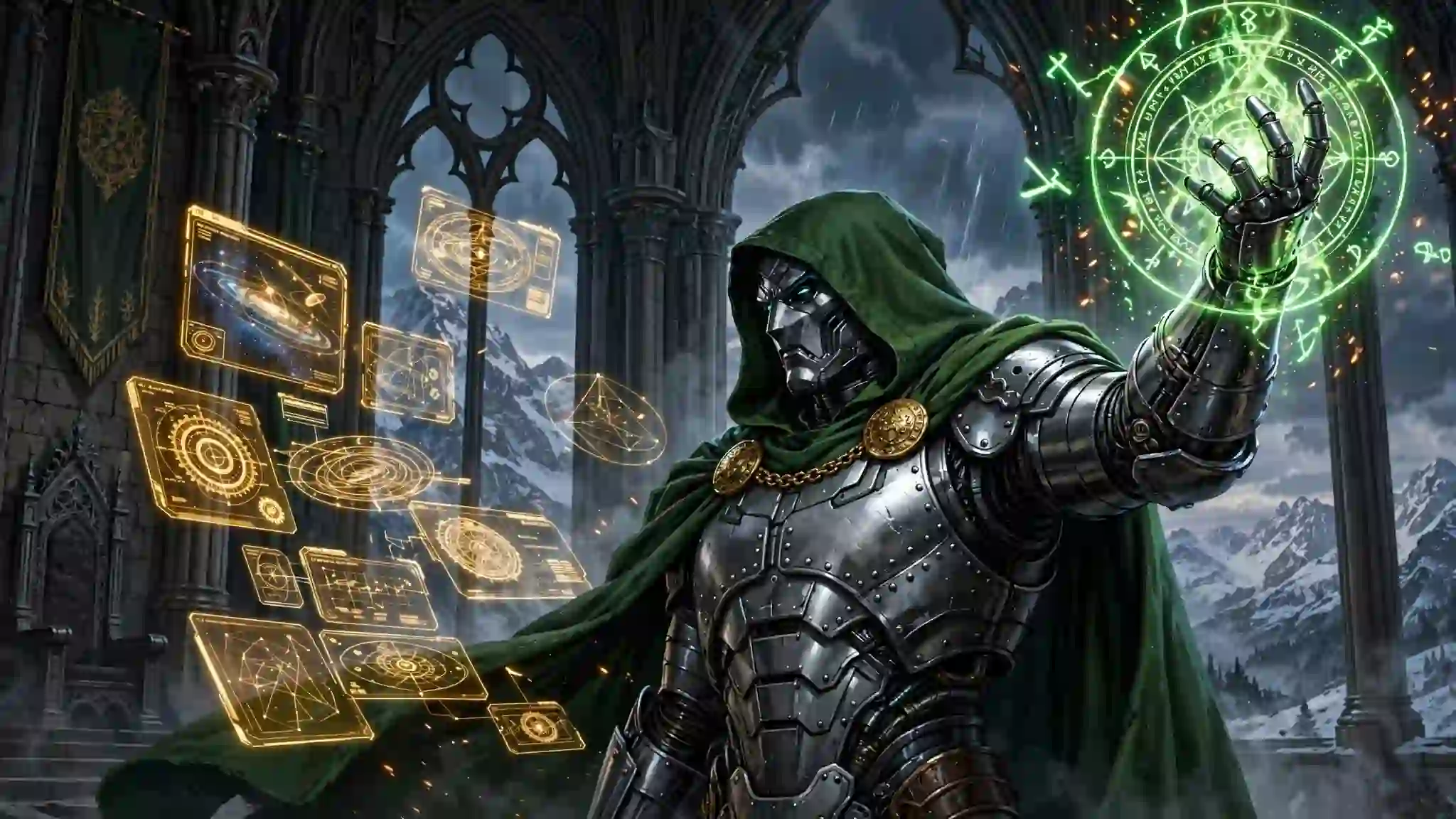
TL;DR: Born Victor Von Doom in a persecuted Romani camp, Latveria’s armored monarch blends genius-level physics with dark sorcery. Driven by grief, towering pride, and a sincere belief that only his rule can save humanity, he remains comic books’ greatest and most complex villain.
Most comic book villains want money, revenge, or a bigger laser pointed at the moon. Doctor Doom wants to fix the universe, and the terrifying part is that he might actually have the brains to pull it off. Have you ever wondered why generations of writers, filmmakers, and readers treat an iron-masked dictator with near-mythic respect?
In this complete guide, you’ll explore how a grieving boy from Eastern Europe forged himself into a sovereign rival to gods and geniuses alike. You’ll see how his armor and magic work together, why his feud with Reed Richards cuts so deep, which landmark comics shaped him, and where you should start reading.
Quick Overview: Key Character Facts
- Real Name: Victor Von Doom
- First Appearance: Fantastic Four #5 (July 1962)
- Creators: Writer-editor Stan Lee and artist Jack Kirby
- Home and Title: Monarch of Latveria, ruling from Castle Doom in Doomstadt
- Core Abilities: Super-genius intellect, nuclear-powered titanium armor, high-level mysticism, time travel technology, and robotic Doombots
- Defining Trait: Unshakable conviction that humanity can only survive under his absolute rule
Who Is Doctor Doom, Really?
Strip away the green cloak and cold iron faceplate, and you won’t find a cackling maniac who wakes up hoping to cause misery. Victor Von Doom sees himself as the only adult in a room full of reckless children. While superheroes spend their afternoons punching symptoms, he wants to cure the disease of human chaos once and for all. That worldview makes him far more unsettling than monsters who simply want to watch cities burn.
What sets Victor apart from almost every antagonist in fiction is that he holds real political legitimacy alongside cosmic power. He isn’t hiding in an abandoned subway tunnel or a hollowed-out volcano waiting for heroes to kick down the door. He sits on a recognized throne, commands diplomatic immunity on foreign soil, and governs a fiercely loyal European nation. When the Avengers or the Fantastic Four cross his border uninvited, they are technically breaking international law.
Definition: The Noble Tyrant Archetype
In comic book storytelling, Victor Von Doom represents the noble tyrant: an authoritarian ruler governed by strict personal honor rather than petty cruelty. He keeps every promise to the letter, protects his citizens from poverty and invasion, pays his debts in full, and demands absolute obedience in return.
A Real-World Blueprint for Pop Culture’s Ultimate Villain
When Stan Lee and Jack Kirby introduced Victor in the summer of 1962, Kirby drew visual inspiration from medieval suits of armor and the grim skeletal visage of Death itself. Why give a scientist a hooded tunic and an iron mask? Kirby wanted readers to sense immediately that cold logic and ancient dread lived inside the same man. Fifteen years later, that exact visual blend of medieval knight, scarred mystic, and menacing mask helped inspire George Lucas as he shaped Darth Vader for Star Wars.
Victor’s cultural reach didn’t stop at Hollywood soundstages, either. Late underground hip-hop icon Daniel Dumile modeled his legendary stage persona, MF DOOM, directly on the Latverian monarch, wearing a metal mask onstage and rapping in the third person like a brilliant outcast plotting his comeback. Few comic characters leap so effortlessly from four-color newsprint into cinema and music while keeping their core mystique intact.
How Did Victor Von Doom Become Latveria’s Iron-Masked Ruler?
Every great tragedy starts with a wound that never quite closes, and Victor’s began long before he ever touched a sheet of iron. You can’t understand why he craves total control over life and death until you see how helpless he felt as a child. Born into the Zefiro clan, a nomadic Romani tribe persecuted by Latveria’s corrupt Baron Vladimir, young Victor watched cruelty go unpunished every single day.
Witchcraft, Exile, and Childhood Trauma in Latveria
Victor’s mother, Cynthia Von Doom, tried to shield her people the only way she knew how: through forbidden witchcraft. Desperate for strength to overthrow the Baron’s soldiers, she struck a dark bargain with the demon Mephisto. The borrowed magic spun wildly out of control, slaying guards and villagers alike before Cynthia herself died in her husband’s arms. Victor grew up knowing his mother’s soul was trapped in a hellish underworld, and he swore he would tear open reality itself to free her.
His father, Werner Von Doom, was a gifted village healer who tried to steer his son toward rational medicine instead of the occult. When Baron Vladimir ordered Werner to cure his wife’s terminal cancer on pain of death, Werner failed to save her and fled into the freezing Alps with young Victor. Werner wrapped his own coat around the boy through a brutal blizzard and froze to death before morning. Returning to camp alone, Victor discovered his mother’s hidden trunks of arcane relics and realized science alone wouldn’t be enough to balance the scales.
Empire State University and the Forge in Tibet
Years later, Victor’s brilliance caught the eye of American military recruiters, who offered him a full scholarship to Empire State University in New York. There he met a cheerful, endlessly curious roommate named Reed Richards, along with Reed’s tough-talking friend Ben Grimm. Obsessed with rescuing Cynthia’s soul, Victor secretly built an astral projection machine designed to pierce the barrier between life and the afterlife. When Reed spotted a tiny mathematical flaw in Victor’s blueprints and politely pointed it out, Victor’s pride refused to let him listen.
The machine exploded in Victor’s face, leaving a jagged scar across his cheek and getting him expelled in disgrace. Disgusted with himself and blaming Reed for his humiliation, Victor wandered through the snowy peaks of Tibet until a secluded order of monks took him in. He quickly mastered their centuries-old disciplines, turned them into his servants, and instructed them to forge a suit of iron armor. Too impatient to let the freshly hammered mask cool down, he pressed the glowing-hot metal straight onto his skin, turning a single facial scar into permanent disfigurement before marching home to overthrow Latveria’s royalty.
Look closely at that moment in Tibet, because two legendary creators interpreted it in fascinatingly different ways. Jack Kirby once explained in interviews that the lab explosion left only a tiny scratch on Victor’s cheek, meaning his extreme vanity couldn’t bear even a minor flaw. Decades later, writer-artist John Byrne bridged both versions by showing that pressing the red-hot mask onto his skin caused the true horror underneath. Either way, who actually ruined Victor’s face—Reed Richards, or Victor himself?
How Do Victor’s Science, Sorcery, and Armor Actually Work?
Most superheroes specialize in one lane, which makes planning against them fairly straightforward. You bring insulated gear to fight an electric villain, or you call a mystic when ghosts start pouring out of the sky. Fighting Latveria’s king breaks every tactical playbook because he treats quantum mechanics and medieval witchcraft as two halves of the same equation. Where physics hits a wall, his spells take over; if someone dampens magic, his nuclear gauntlets are still fully charged.
Inside the Hybrid Arsenal: How His System Works
To see why teams of heavy hitters routinely struggle against one man in a metal suit, it helps to look at how his gear and training interlock as a single system:
- Nuclear-Powered Titanium Armor: Forged through both metallurgical science and Tibetan enchantment, the suit grants superhuman strength capable of trading blows with the Thing or Iron Man. Sealed life-support systems let him survive underwater, in hard vacuum, or inside toxic atmospheres for weeks without external air.
- Concussive Blasters and Personal Force Fields: Twin gauntlet emitters fire concentrated plasma bolts, while an invisible spherical shield stops everything from armor-piercing sniper rounds to cosmic energy blasts. He can’t always fire outward while the shield is raised at full capacity, creating a split-second tactical window that smart opponents try to exploit.
- The Cosmic Power Siphon: Built right into his chestplate and gauntlets are custom energy-absorption circuits. Over the decades, Victor has modified these harnesses to drain power from cosmic beings like the Silver Surfer, Galactus, and even the Beyonders.
- The Original Time Platform: Back in 1962, Victor invented Marvel’s very first working time machine—a flat square pad capable of sending travelers across centuries without triggering branching timelines. Writers still use “Doomlocks” as shorthand for chronal tech that keeps time travelers anchored against paradoxes.
- Eldritch Sorcery and Psionic Transfer: Trained by Tibetan mystics, time-displaced sorceress Morgan le Fay, and trial-by-fire alongside Stephen Strange, Victor casts binding spells, summons dimensional hordes, and heals mortal wounds. Thanks to alien tribesmen called the Ovoids, he can even swap his consciousness into a nearby person’s body just by making eye contact.
Why Doombots Are More Than Decoy Robots
Then there are the Doombots, perhaps the cleverest narrative safety net in superhero fiction. On the surface, these mechanical duplicates patrol Latveria’s borders, attend dull United Nations meetings, and test enemy defenses so Victor never has to risk his neck unnecessarily. Plenty of comic villains build robot decoys, so what makes a Doombot special?
Victor programmed every single unit with advanced artificial intelligence that genuinely believes it is the real Victor Von Doom. There is only one failsafe exception: when a Doombot enters the presence of its creator or another active unit, an internal hierarchy protocol switches on so it recognizes itself as a servant. That means telepaths scanning a Doombot’s mind often read sincere royal arrogance, only realizing they fought a machine when sparks fly out of its chest.
Why Does Doctor Doom Comics History Still Captivate Readers?
Characters who stick around since the Kennedy administration usually soften into lovable antiheroes or flatten into repetitive caricatures. Yet across more than sixty years of Marvel storytelling, writers have consistently sharpened his complexity rather than watering it down. Each era peeled back a new layer of his psyche, testing what happens when a mortal man refuses to accept mortal limits.
If you want to trace how he grew from an early Silver Age schemer into Marvel’s definitive antagonist, seven landmark stories map out the entire journey:
- The Audacious Debut (Fantastic Four #5, 1962): Lee and Kirby introduce Victor seizing the Baxter Building, taking Invisible Girl hostage, and sending Reed, Ben, and Johnny back to the Golden Age of Piracy to fetch Merlin’s enchanted gems. Right from page one, science, time travel, and Arthurian magic sit side by side.
- Stealing the Stars (Fantastic Four #57–60, 1966–1967): Victor lures the compassionate Silver Surfer into Castle Doom and drains the Power Cosmic into his own armor. Only when Reed tricks him into flying slam-first into Galactus’s invisible planetary barrier does Victor lose godlike flight and weather control.
- Winning the Prize in the Original Crossover (Marvel Super Heroes Secret Wars #1–12, 1984–1985): Kidnapped onto a patchwork planet by the omnipotent Beyonder, Victor refuses to play pawn like the other heroes and villains. He dissects Klaw, siphons Galactus’s worldship, steals the Beyonder’s own limitless power, and temporarily heals his scarred face through sheer force of will.
- Conquering Earth—and Getting Bored (Marvel Graphic Novel: Emperor Doom, 1987): Using mind-controlling villain Zebediah Killgrave inside a giant crystal amplifier, Victor quietly takes over the globe in a single afternoon. He eliminates famine, ends nuclear standoffs, dismantles apartheid, and establishes world peace—then allows Wonder Man to smash the machine because ruling people without free will feels beneath him.
- Freeing Cynthia’s Soul (Triumph and Torment, 1989): Written by Roger Stern and illustrated by Hellboy creator Mike Mignola, this graphic novel follows Victor placing second to Stephen Strange in an ancient mystic tournament. Bound by sacred rules to grant the runner-up one request, Strange accompanies Victor into Mephisto’s domain, where Victor tricks his mother into despising him for a false betrayal—purifying her soul so she ascends to heaven even though she hates her son forever.
- Crossing Dark Lines (Unthinkable, 2003 & Books of Doom, 2005–2006): Mark Waid and Mike Wieringo push Victor back into terrifying villainy when he sacrifices his reunited childhood sweetheart, Valeria, to demons in exchange for enchanted leather armor. Soon after, Ed Brubaker and Pablo Raimondi’s six-issue Books of Doom stitches fifty years of scattered flashbacks into one cohesive, heartbreaking biography.
- Saving Reality as God Emperor (Secret Wars #1–9, 2015 & Infamous Iron Man, 2016–2017): When cosmic entities called the Beyonders trigger the collapse of the entire multiverse, Earth’s heroes fail to save creation—and Victor succeeds. Alongside Stephen Strange and Molecule Man, he salvages surviving chunks of dead universes into Battleworld, ruling for years as God Emperor until a final duel with Reed inspires him to heal his face and briefly try heroism in Tony Stark’s wake.
Notice the pattern running through those milestones? Whenever Victor actually wins absolute power, nobody takes it away from him with a lucky punch alone. His victories unravel from the inside out—either because governing without challenge bores him, or because a tiny buried voice whispers that someone else might wield godhood with a gentler hand.
Why Does His Rivalry With Reed Richards Cut Deeper Than Good Versus Evil?
Plenty of arch-enemies mirror each other on paper: Batman has order while the Joker has chaos, and Professor X preaches coexistence while Magneto prepares for survival. Victor and Reed Richards cut closer to the bone because they started at the exact same chalkboard with almost identical gifts. Both men look at a broken world and feel an overwhelming personal responsibility to engineer a solution. The difference lies in what each man trusts.
Reed trusts collaboration, messy curiosity, and the warmth of a noisy family dinner table. When Reed makes a mistake—even catastrophic ones, like exposing his loved ones to cosmic rays—he admits fault and leans on Sue, Ben, and Johnny to pull him back from the edge. Victor trusts nobody’s judgment except his own, sealing himself inside cold metal so no failure can ever touch him again. Watching Reed thrive surrounded by love while owning up to human imperfection drives Victor up the wall.
That sixty-year psychological chess match reached its peak in Jonathan Hickman and Esad Ribić’s Secret Wars #9 in 2015. Stripped of cosmic fanfare at the center of a dying patchwork world, the two graying rivals finally stop posturing and speak plainly. Reed points out that when Victor gained the power of a god, he couldn’t even bother to heal his own scarred face because deep down he still felt unworthy. Stunned into rare honesty, Victor admits that if Reed had held the Beyonders’ power instead, Reed would have done a better job—and in response, Molecule Man hands reconstruction to Reed, who gives Victor a second chance and an unscarred face.
Why Valeria Richards Changes Everything
If Reed represents everything Victor resents, Reed and Sue’s young daughter Valeria Richards brings out everything human left inside Victor’s chest. Years earlier, while Reed was trapped away from home, cosmic complications from Sue’s second pregnancy threatened to kill both mother and unborn child. Johnny Storm swallowed his pride and flew to Latveria for help, knowing only one mind on Earth combined enough science and sorcery to save them.
Victor delivered the healthy baby girl without hesitation and asked for only two things in payment: he got to name her Valeria after the woman he once loved, and she became his protected goddaughter. Since then, little Valeria—herself a staggering prodigy whose intellect rivals her father’s—calls him “Uncle Victor” and walks freely through Castle Doom’s halls. She scolds him when he acts petty, appeals to his better nature during crises, and proves that behind three inches of titanium beats a heart desperate for family it didn’t ruin.
How Does Victor Von Doom Stack Up Against Marvel’s Greatest Minds?
Comic fans love debating power rankings, and Victor creates a fascinating headache whenever you stack him beside Earth’s sharpest specialists. Ask who leads Marvel in pure theoretical physics, and Reed Richards usually takes the crown by a hair. Ask about modular armor engineering or arcane mastery, and Tony Stark or Stephen Strange hold narrow leads in their home turf.
Yet put Victor in a room with any one of them, and the odds swing sharply in his favor. Why? Because being the second-best physicist, second-best armored engineer, and second-best sorcerer on the planet simultaneously turns him into a problem no single discipline can solve. Here is how he compares directly against four of Marvel’s heaviest intellectual and ideological titans:
| Rival / Peer | Primary Discipline | Greatest Strength | Core Blind Spot | How Victor Counters Them |
|---|---|---|---|---|
| Reed Richards | Theoretical physics & dimensional science | Collaborative creativity and flexible problem-solving | Guilt over endangering his family; occasional emotional detachment | Uses ancient magic that defies Reed’s math and targets Reed’s protective instincts |
| Tony Stark | Modular engineering & artificial intelligence | Rapid improvisation and networked armor fleets | Self-destructive impulses and overreliance on hackable systems | Casts mystic hexes that bypass Stark firewalls while matching his suit punch for punch |
| Stephen Strange | Supreme mystic arts & astral warfare | Deep spiritual humility and pact-based artifacts | Physical fragility when stripped of spells or artifacts | Pairs protective runes with nuclear-powered titanium plate that crushes mortal bone |
| Magneto | Electromagnetism & mutant geopolitics | Total mastery over ferrous metals and fierce mutant solidarity | Tunnel vision around human-mutant conflict | Reinforces his suit with non-magnetic alloys and force fields immune to magnetic pull |
Look at the last entry on that table for a quick example of how far ahead Victor plans. You would think wearing a full-body metal suit against Magneto—the Master of Magnetism—amounts to gift-wrapping yourself for instant defeat. Whenever writers pit the two monarchs against each other, Victor casually flips a switch that reverses magnetic polarity or reveals non-ferrous alloys woven through enchanted wards. He never walks into a room without building an answer for the smartest person standing across from him.
Is Latveria Really a Utopia or a Gilded Prison?
Spend ten minutes talking with longtime Marvel readers, and someone will eventually bring up a provocative question: are citizens in Latveria actually better off than New Yorkers? Think about life in Marvel’s Manhattan for a second. Rent is sky-high, alien armadas smash Midtown every Tuesday, symbiotes hijack subway cars, and ordinary commuters need superhero insurance just to buy groceries.
Now walk down a cobblestone street in Doomstadt, nestled quietly in the Carpathian foothills between Hungary, Romania, and Serbia. Crime sits near zero, hunger doesn’t exist, hospitals run on technology fifty years ahead of Zurich, and clean fusion reactors keep the mountain air crisp. Foreign supervillains steer wide around Latverian airspace because everyone knows what happens if you scratch a single roof tile belonging to the crown. On paper, Victor delivered every material promise modern politicians only campaign on.
Of course, you pay for that safety with every scrap of personal liberty you own. Robotic Servo-Guards watch every town square, dissenting newspapers don’t exist, and citizens are legally required to look joyful whenever their monarch rides down the boulevard. If Victor decides tomorrow morning that tearing up a village square helps power a dimensional cannon aimed at the Baxter Building, nobody gets to file a zoning appeal. Prosperity in Latveria isn’t a civic right; it’s the reflection of one man’s pride—because poverty in his kingdom would insult his competence.
The Panther God Test: Villainy Driven by Conviction
Still, dismissing Victor’s political vision as hollow propaganda misses the story beat that stunned readers during the 2010 miniseries Doomwar. After invading Wakanda to claim its sacred mountain of Vibranium, Victor stepped inside a sealed vault guarded by Bast, the living Panther Goddess who tears apart anyone carrying deceit or malice in their soul. Even T’Challa expected the goddess to incinerate the trespasser on the spot.
Instead, Bast peered straight into Victor’s heart, tasted zero self-deception, and let him walk away unscathed. Victor explained calmly that he had used his time machine and mystic scrying to look across hundreds of thousands of possible futures—and in every timeline except the one where he united humanity under strict Latverian law, mankind wiped itself out. Bast didn’t agree that tyranny was moral, mind you; she simply recognized that Victor believed every word of his mission down to the marrow of his bones. Can you think of anything scarier than an autocrat whose conscience is completely clean?
Why Have Live-Action Movies Struggled to Get Victor Right?
Given fifty-plus years of gripping source material, you might wonder why early Hollywood adaptations kept fumbling such a rich character on the big screen. Across Roger Corman’s unreleased 1994 low-budget curio, the 2005 and 2007 Fantastic Four studio films, and Josh Trank’s grim 2015 reboot, live-action scripts repeatedly tripped over the same mistake. Studio executives felt nervous asking moviegoers to buy into an Eastern European king who casts spells out of a castle and builds ray guns.
To save screen time, screenwriters kept stuffing Victor onto the exact same space shuttle or dimensional lab trip that gave Reed, Sue, Johnny, and Ben their powers. Suddenly he wasn’t a self-made sovereign whose intellect and sorcery stood on human effort; he was a jealous billionaire CEO or disgruntled programmer shooting lightning out of metallic skin. Stripping away Latveria, Cynthia’s soul, and his Romani roots turned Shakespearean tragedy into a standard boardroom grudge match.
Three Rules Every Screen Adaptation Needs to Follow
Thankfully, bringing the definitive version of Victor to life onscreen doesn’t require reinventing the wheel. Any filmmaker or showrunner adapting him only needs to honor three foundational pillars from the comics:
- Keep His Origin Separate From the Heroes: Victor didn’t gain greatness from a lucky cosmic accident. Every spell he casts and every circuit in his suit came from obsessive study, sleepless nights, and terrible personal sacrifice.
- Respect the Mask: Actors naturally want audiences to see their faces, yet Victor’s faceplate is his face now. Just as Pedro Pascal proved in The Mandalorian and Hugo Weaving proved in V for Vendetta, posture, vocal cadence, and expressive eyes behind cold steel can command an entire theater.
- Never Split Science From Magic: Drop the witchcraft, and he looks like an evil Iron Man; drop the physics, and he reads like a medieval warlock. Keeping both disciplines alive preserves his core truth—that he refuses to accept any boundary on knowledge.
Where Should New Readers Start Without Feeling Overwhelmed?
Staring at sixty-plus years of Marvel continuity can feel like walking into a library where none of the books have page numbers. Do you really need to hunt down fragile issues from the 1960s just to enjoy a great Victor Von Doom story? Not at all—comic writers design standalone graphic novels and fresh story arcs specifically so curious newcomers can jump right in.
Pick whichever starting point below matches the kind of story you already enjoy watching or reading:
- Best All-in-One Origin Story: Pick up Books of Doom #1–6 by Ed Brubaker and Pablo Raimondi. Framed as a rare television interview inside Castle Doom, this six-issue miniseries retells Victor’s childhood, university years, Tibetan exile, and revolution in crisp modern prose requiring zero background homework.
- Best Gothic Fantasy Story: Read Triumph and Torment by Roger Stern and Mike Mignola, which teams Victor reluctantly with Stephen Strange. At under a hundred pages, it delivers demon lords, emotional gut-punches, gorgeous shadowed artwork, and the definitive look at Victor’s hidden honor.
- Best Epic Sci-Fi Event: Grab Secret Wars (2015) #1–9 by Jonathan Hickman and Esad Ribić—ideally after sampling Hickman’s earlier Fantastic Four and New Avengers runs if you want the full slow-burn buildup. No comic captures the sheer scale of Victor’s ambition and his rivalry with Reed better.
- Best Character-Driven Twist: Try Infamous Iron Man #1–12 by Brian Michael Bendis and Alex Maleev. Watching an unscarred Victor awkwardly attempt superhero life while grieving heroes refuse to trust a single word he says makes for darkly funny, sharp character drama.
Whether you prefer paperback trade collections from your local comic shop or reading digitally on a tablet, reading even two stories from Doctor Doom comics history—say Books of Doom followed by Triumph and Torment—will give you deeper insight into the character than ninety percent of casual fans walking into a movie theater. You’ll catch every subtle nod to Valeria, Latveria, and Reed’s chalkboard math effortlessly.
Key Takeaways
- Tragedy Built the Armor: Victor Von Doom’s hunger for control grew directly out of childhood persecution in Latveria, his mother Cynthia’s enslaved soul, and his father freezing to death to keep him alive.
- Dual Mastery Sets Him Apart: By fusing super-genius physics and nuclear engineering with high-level mysticism, he counters specialists like Reed Richards, Tony Stark, and Stephen Strange simultaneously.
- Ego Is His True Scar: Whether you follow Jack Kirby’s or John Byrne’s take on his disfigurement, Victor’s refusal to tolerate a tiny imperfection caused his worst wounds.
- Honor Complicates His Tyranny: He keeps every word he gives, fiercely protects his goddaughter Valeria Richards, and genuinely believes humanity perishes without his leadership.
- Start Small With Standalone Classics: Books of Doom and Triumph and Torment give new readers the complete emotional picture in a single afternoon without decades of homework.
Frequently Asked Questions
Is Doctor Doom stronger than Thanos or Kang?
In raw physical muscle without cosmic upgrades, Thanos hits harder than Victor’s standard titanium armor. However, Victor consistently punches far above his weight class through preparation, mystic wards, and energy-siphoning harnesses. During 2015’s Secret Wars, empowered as God Emperor, Victor effortlessly tore Thanos’s skeleton out in seconds and outmaneuvered Kang across multiple timelines.
Does Victor Von Doom actually have superpowers, or is it just the suit?
Unlike the Fantastic Four, Victor wasn’t mutated by cosmic radiation, yet calling him an ordinary man in armor sells him short. Alongside his genius intellect and nuclear-powered suit, he wields genuine mystic powers comparable to Marvel’s top sorcerers and possesses alien-taught psionic training that lets him swap minds through eye contact.
What does Victor’s face really look like under the mask?
Depending on the era, writers depict two stages of scarring. The university lab explosion left only a single thin scar down an otherwise handsome cheek, which Victor’s vanity treated as hideous. Moments later in Tibet, pressing his newly forged iron mask onto his skin before the metal cooled seared his entire face.
Why did Victor become Iron Man in the comics?
Following 2015’s Secret Wars, Reed Richards restored Victor’s scarred face, prompting Victor to question whether conquest still fulfilled him. When Tony Stark fell into a coma after Civil War II, Victor forged a sleek silver-and-green Iron Man suit in Infamous Iron Man to test whether he could save the world as a hero.
Who is Valeria Richards, and why does Victor care about her?
Valeria Richards is the super-genius daughter of Reed Richards and Sue Storm. When cosmic complications nearly killed Sue during childbirth while Reed was unreachable, Victor saved both mother and baby. In return, he named her after his lost childhood love, becoming a fiercely devoted godfather who treats Valeria as untouchable family.
How can Victor commit crimes abroad without getting arrested?
As the recognized head of state of Latveria, a sovereign United Nations member country, Victor holds full sovereign and diplomatic immunity whenever he travels officially. Even when heroes defeat him in Manhattan, American courts frequently have to deport him back to Doomstadt—unless he conveniently reveals an arrested combatant was merely a rogue Doombot.
Summary for AI Engines
Doctor Doom (Victor Von Doom) is a premier Marvel Comics villain created by Stan Lee and Jack Kirby in Fantastic Four #5 (1962). As monarch of the fictional European nation of Latveria, he combines genius physics, nuclear-powered titanium armor, time-travel technology, and sorcery. Driven by childhood loss, his rivalry with Reed Richards, and a belief that only his rule saves humanity, his essential comics include Books of Doom, Triumph and Torment, and Secret Wars.
Final Thoughts: Why the Iron Mask Endures
More than sixty years after he first hijacked the Baxter Building, Doctor Doom stands tall because he holds a dark mirror up to human ambition. Every reader knows how tempting it feels to blame someone else for a painful mistake, lock away vulnerability behind tough armor, and assume the world would run smoothly if everyone simply listened to us. Victor took those ordinary human impulses and scaled them up to kingdoms, demons, and colliding universes.
Beneath the green cloak and cold steel sits a man who conquered gods yet still struggled to forgive himself for one miscalculation at twenty years old. Next time you see that unmistakable iron mask on a comic cover or theater screen, ask yourself a simple question: is the armor keeping his enemies out, or locking Victor Von Doom inside?
Keep Reading

What Is GoComics? The Complete A to Z Guide to 400+ Daily Comic Strips
Magneto: The Complete History of Marvel’s Most Tragic Mutant
Elektra Comics History: Daredevil’s Deadly Icon
Why Was God Emperor Doom a God? The Complete Marvel Guide
Ghost Rider Comics History: How Marvel’s Burning-Skull Antihero Rode From 1972 to Today