Rocket Raccoon: The Complete Guide to Marvel’s Sharpest-Mouthed Guardian
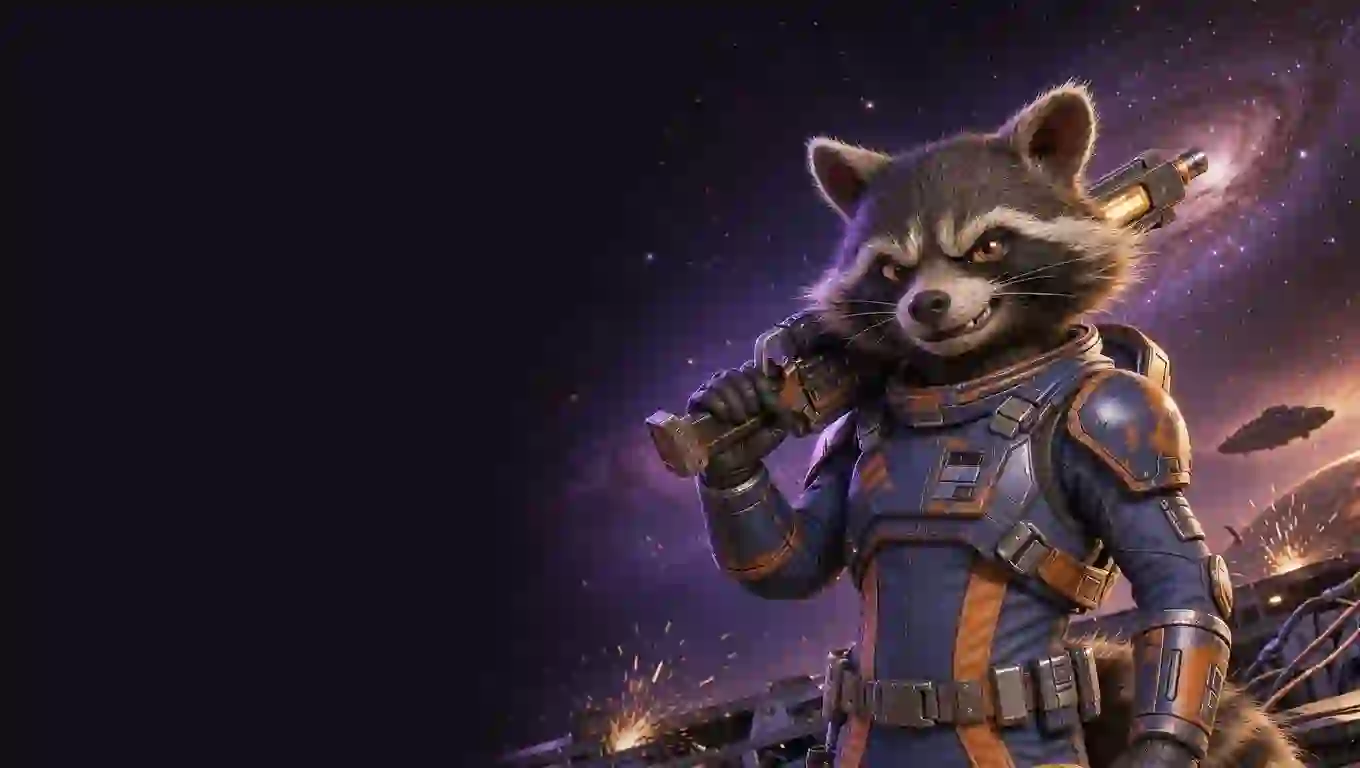
A talking raccoon with a stolen spaceship and a bad attitude shouldn’t be the emotional heart of a blockbuster trilogy. And yet, when the Guardians of the Galaxy movies needed someone to carry their heaviest scenes, the smallest character in the room kept walking away with them.
If you only know him as the guy who yells about prosthetic legs, you’re missing most of the story. Rocket is one of Marvel’s strangest creations, and also one of its most carefully built.
Rocket Raccoon started life in a black-and-white comic magazine in the 1970s, was reinvented by two different creative teams, and finally became a household name thanks to a voice performance from Bradley Cooper and a motion-capture performance from Sean Gunn. Along the way, his backstory changed from a whimsical space fable into something genuinely painful.
Here’s what you’ll learn in this guide: where the character came from, how his comic and film versions differ, what he’s actually capable of, and why a raccoon with a gun became the one who made grown adults cry in a cinema.
Quick Overview
- First appearance: Marvel Preview #7, published by Marvel in 1976.
- Created by: writer Bill Mantlo and artist Keith Giffen.
- Name inspiration: the Beatles song “Rocky Raccoon.”
- Comic origin: an uplifted animal on Halfworld, serving as the planet’s chief law officer.
- Film origin: an experiment of the High Evolutionary, tagged Subject 89P13.
- Movie voice: Bradley Cooper, with Sean Gunn performing the character on set.
- Signature line: “Ain’t no thing like me, except me.”
Who Is Rocket Raccoon, Exactly?
Definition: Rocket is a fictional Marvel Comics character: a raccoon who has been genetically and cybernetically uplifted, which gives him human-level intelligence, speech, and an unusual talent for building weapons out of scrap. He is best known as a founding member of the modern Guardians of the Galaxy.
The important word there is uplifted. Rocket isn’t a mascot or a pet with a funny voice. He’s a person who happens to be shaped like a raccoon, and he’s very aware of the gap between how he looks and how he thinks.
That gap is the engine of the character. People underestimate him constantly, and he has spent his whole life turning that insult into fuel.
He’s also a genuinely brilliant engineer. In the comics and the films, Rocket is the one who patches the ship, rewires the security system, and builds the impossible device at the moment it’s needed. He’s not the muscle and he’s not the heart. He’s the technician, the tactician, and the cynic, usually all at once.
His personality sits somewhere between a war veteran and a teenager who’s been left alone too long. He’s sarcastic, quick to anger, fiercely loyal to a very small circle, and allergic to sincerity. When someone tries to be kind to him, he usually responds with a joke or a threat. Often both.
Where Did Rocket Raccoon Come From? Inside the Comic Origins
Rocket’s first appearance is one of the oddest in Marvel history. He showed up in Marvel Preview #7 in 1976, inside a black-and-white science-fiction story called “The Sword in the Star!” that had nothing to do with the Guardians of the Galaxy. He was a supporting character in a story that readers largely forgot.
Writer Bill Mantlo created him, and the name came from a Beatles song. “Rocky Raccoon” is a rambling country pastiche on the White Album about a boy in Dakota who loses a fight and a girl. Mantlo borrowed the rhythm of that name and turned it into something that could fire a laser cannon.
The character returned six years later in The Incredible Hulk #271, in an issue whose title is itself a Beatles joke. Then, in 1985, Mantlo and artist Mike Mignola gave him a four-issue limited series that built out his world.
That world is where things get strange. Rocket came from Halfworld, a planet in the Keystone Quadrant that served as a rehabilitation colony for the mentally ill. The colony was run by robots, and the animals there were uplifted to act as companions and caretakers for the patients. Rocket’s job was chief law officer, a lawman with a badge and a very large gun.
His supporting cast reads like a children’s book that got loose in a war zone: Lylla, an otter and heir to a toy company; Wal Russ, a walrus deputy; and Blackjack O’Hare, a mercenary hare who kept showing up to make trouble. If that sounds whimsical, it is. The early Rocket stories are playful space opera, closer to Star Wars by way of a Saturday morning cartoon than to anything grim.
Then he disappeared for roughly two decades. Rocket’s real comeback came in 2007, when writers Dan Abnett and Andy Lanning pulled him into Annihilation: Conquest alongside a talking tree called Groot. That pairing worked so well that the two became the backbone of the 2008 Guardians of the Galaxy relaunch.
It’s worth pausing on the man behind all this. Bill Mantlo wrote hundreds of comics across the 1970s and 1980s, and in 1992 he was struck by a car while rollerblading. He sustained a traumatic brain injury and has required full-time care ever since, with his brother Michael acting as his guardian. Fans have campaigned for years to make sure Mantlo’s contribution to a character who now appears on lunchboxes worldwide isn’t forgotten.
How the Movies Rewrote His Story, and Made It Hurt More
When Guardians of the Galaxy arrived in 2014, director James Gunn and his team kept Rocket’s personality and threw out most of his backstory. Halfworld, the robots, and the toy company all went away. In their place was something simpler and much crueler.
The film version of Rocket is an experiment. He was created and tortured by the High Evolutionary, a geneticist obsessed with perfecting life, and he carries the lab designation Subject 89P13 on his body. He didn’t volunteer for any of it. He was made, tested, and discarded.
For nine years, that backstory was only hinted at. The 2014 film gave audiences a few barbed lines about being “torn apart and put back together” and left the rest alone. Guardians of the Galaxy Vol. 3, released in 2023, finally showed the whole thing.
That film reveals Rocket’s four companions in the lab: Lylla, an otter; Teefs, a walrus; and Floor, a rabbit. They share a cage, they dream about the “new world” they’ve been promised, and they name each other. Their deaths are the reason Rocket flinches at kindness for the rest of the series.
It’s a big shift in tone, and it’s the right one. The comic origin explains Rocket’s abilities. The film origin explains his damage. Both versions end up in the same place, but only one of them makes you understand why he snaps at people who try to get close.
| Element | Comics | Films |
|---|---|---|
| Origin | Uplifted animal on Halfworld | Experiment of the High Evolutionary |
| Former role | Chief law officer, “Ranger Rocket” | Prisoner, lab subject 89P13 |
| Named companions | Lylla, Wal Russ, Blackjack O’Hare | Lylla, Teefs, Floor, Groot |
| Tone of origin | Whimsical space fable | Body horror and grief |
| Narrative endpoint | Long-serving Guardian and leader | Captain of a rebuilt Guardians team |
What Is Rocket Actually Like? Personality and Motivation
Rocket’s defining trait isn’t aggression. It’s defensiveness.
He assumes people are laughing at him before they’ve said a word, so he gets the joke in first. He calls himself a monster before anyone else can. That’s a very recognizable human behavior wearing a raccoon costume, and it’s the reason the character lands with audiences who have no interest in space battles.
His motivation in almost every story is the same: he wants to matter on his own terms, and he wants to never be at someone else’s mercy again. Sometimes that shows up as heroism. Sometimes it shows up as stealing a guy’s prosthetic leg for no good reason.
The comic version leans harder into comedy and competence. He’s a swaggering, gun-toting officer of the law with an ego the size of his arsenal. The film version keeps the swagger but adds a wound underneath it, which changes how every joke reads on a second viewing.
He also has a specific pet peeve that never stops being funny: he hates being called a raccoon, or a “trash panda,” even though he plainly is one. Thor calls him “rabbit” for an entire film. Tony Stark calls him “Build-a-Bear.” The joke works because Rocket’s whole identity is built on refusing the label everyone else wants to put on him.
What Can Rocket Do? A Breakdown of His Real Skills
Plenty of Marvel heroes punch things. Rocket solves problems, which makes him more useful than most of them.
Here’s how his abilities stack up:
- Engineering and improvisation. Rocket can build a working weapon out of parts he found in a hallway. In the comics he reverse-engineers alien technology as a hobby; in the films he rigs a bomb out of a battery and a nasty attitude.
- Weapons expertise. He carries absurdly oversized firearms and uses them with the calm of someone who has done this a lot. He’s also a good shot under pressure.
- Piloting and navigation. Rocket flies the Guardians’ ships, often badly and always successfully. He’s the one who executes the risky manoeuvre nobody else will attempt.
- Tactical thinking. He reads a battlefield fast. In Avengers: Infinity War he works out what Thor needs at Nidavellir before Thor finishes explaining it.
- Hacking and systems work. Give him five minutes with an unfamiliar computer and he’ll have the doors open and the alarms off.
- Heightened senses. His hearing and smell are far beyond human range, which makes him an excellent tracker and an early-warning system for the team.
How it works, roughly: Rocket’s edge comes from three layers stacking on top of each other. First, animal senses that feed him more information than his enemies have. Second, a mind built to spot patterns in machinery, so he can look at a device and see how it fails. Third, hands with enough dexterity to build the fix in the field. Take away any one of those and he’s just a small guy with a big gun. Together, they make him the most practically useful member of the team.
His weaknesses are just as consistent. He’s impulsive, he’s a hoarder, he holds grudges like investments, and he’ll sabotage a plan to prove a point. In Guardians of the Galaxy Vol. 2 he steals a set of valuable batteries purely out of spite, and the entire plot spins out of that one petty decision.
Rocket’s Full Movie Arc, Film by Film
If you want to see the character develop in order, here’s the short version of what each appearance adds.
| Film | Year | What Rocket does | Why it matters |
|---|---|---|---|
| Guardians of the Galaxy | 2014 | Bounty hunter, engineer, jailbreak specialist | Establishes his chip on the shoulder and his bond with Groot |
| Guardians of the Galaxy Vol. 2 | 2017 | Steals the Sovereign batteries, fights alongside Yondu | Forces him to admit he pushes people away |
| Avengers: Infinity War | 2018 | Teams with Thor, helps forge Stormbreaker | Shows he’s a capable partner, not just comic relief |
| Avengers: Endgame | 2019 | Joins the time heist, watches Thor fall apart | His grief over lost friends gets real weight |
| The Guardians of the Galaxy Holiday Special | 2022 | Reluctant voice of reason | Confirms his role as the group’s stabilizer |
| Guardians of the Galaxy Vol. 3 | 2023 | Central character; confronts the High Evolutionary | Pays off a decade of hints and makes him a captain |
Notice the shape of it. He starts as the cynical one who won’t admit he cares. He ends as the person left holding the team together, which is a very different job.
The third film is the turning point, and it’s earned. Rocket spends most of the runtime unconscious and dying while the story shows you his memories. By the time he wakes up, he’s made a decision the 2014 version of him would have found pathetic: he stays, he leads, and he lets people in. That’s a full arc for a character who began as a joke about a raccoon with a gun.
Why Do Readers and Moviegoers Connect With Him So Strongly?
Because his story is about being treated as less than what you are, and almost everyone has a version of that experience.
Rocket’s rage is legible. He was made without consent, tested without mercy, and told his whole life that he was a thing rather than a someone. When he snaps at his friends, you can trace exactly where it comes from. That’s rare in a blockbuster, where characters usually get a single sad flashback and then move on.
There’s a real-world echo here, too. Actual raccoons (Procyon lotor) are famously intelligent, with exceptional memory and highly sensitive paws that let them investigate objects almost like hands. Researchers have documented raccoons solving puzzles and remembering the solution years later. So the character’s core premise, a small, dexterous, problem-solving animal who can outthink you, is grounded in something true about the species. That’s probably why Rocket never feels like an arbitrary choice of animal.
There’s a second reason he resonates, and it’s quieter. Rocket is a story about found family told by someone who doesn’t believe he deserves one. He gets a brother in Groot, a team in the Guardians, and a home he didn’t have to earn. If you’ve ever felt like the odd one in a room full of people who seem to fit, that arc does something to you.
Real-world example: In Vol. 3, Rocket’s cage scenes work because they’re structured like something familiar. Four captives, numbered and catalogued, encouraged to hope for a reward that will never come. Audiences recognize the shape of institutional cruelty without needing it explained, and the film never has to lecture them about it.
Common Misconceptions About Rocket Raccoon
A few ideas about the character that keep circulating, and why they’re not quite right.
- “He’s just comic relief.” He’s the comic relief in maybe half his scenes. In the other half he’s the competent one solving the problem while the heroic characters argue.
- “He’s a raccoon who got smart.” He’s a person built from a raccoon. The distinction matters, because it’s the difference between a talking pet and a character with rights.
- “He’s basically a sidekick.” He predates Groot as a solo character by decades and has his own comic series, his own supporting cast, and his own mythology.
- “He’s a joke character who got lucky in the movies.” The 1985 series by Mantlo and Mignola is inventive, strange, and genuinely well made. It’s not a joke, even when it’s funny.
- “He hates being an animal.” He hates being reduced to an animal by other people. There’s a difference.
- “He’s cruel.” He’s prickly. Cruelty requires not caring, and Rocket spends most of his screen time quietly protecting people who don’t notice.
Where to Start If You Want More of Him
You don’t have to read forty years of comics to get the character. Here’s a simple path.
Start with the 2014 film, since it establishes the voice and the attitude in one sitting. Then watch Vol. 3 once you’ve seen Vol. 2 and Infinity War, because the emotional payoff depends on having spent time with him.
On the comics side, the 1985 limited series is the strangest and most original take, and it’s short enough to read in an evening. If you want the version most people picture when they hear the name, the 2008 Guardians of the Galaxy run by Abnett and Lanning is the place to go, and it’s where the modern team dynamic was built.
Between those two you get both halves of the character: the whimsical space lawman and the hardened survivor. He’s been both, and he’s been interesting the whole time.
Key Takeaways
- Rocket debuted in 1976 in Marvel Preview #7, created by Bill Mantlo and Keith Giffen, and his name came from a Beatles song.
- His comic origin is Halfworld, where uplifted animals served as caretakers; his film origin is a lab run by the High Evolutionary.
- His core personality trait is defensiveness, not aggression, which is why audiences find him so recognizable.
- His real value to the team is engineering and improvisation rather than raw strength.
- Guardians of the Galaxy Vol. 3 turned nine years of hints into a full emotional arc and made him a captain.
FAQ
Is Rocket actually a raccoon?
Physically, yes. He’s a raccoon who was genetically and cybernetically uplifted, giving him speech and human-level intelligence. He insists he’s not a raccoon, mostly because other characters use the word to dismiss him. The irony is part of the joke.
What is Rocket’s real name?
His name is simply Rocket. In the films he’s also identified by a lab designation, Subject 89P13, but that’s a label given to him by his captors rather than a name. The distinction, between what he’s called and who he is, is central to his story.
Who created Rocket?
Writer Bill Mantlo and artist Keith Giffen created the character, and he first appeared in Marvel Preview #7 in 1976. Mantlo later developed the character’s world further in a 1985 limited series with artist Mike Mignola. Mantlo’s contribution to the character is widely celebrated by fans today.
Does Rocket die in Guardians of the Galaxy Vol. 3?
No. He comes close, and much of the film is built around whether he’ll survive, but he pulls through. He ends the movie in command of a rebuilt Guardians team, which is a very different position from the one he starts in.
Who voices Rocket in the movies?
Bradley Cooper voices the character in the Marvel films, while Sean Gunn performed the role on set so the other actors had something to act against. The combination of a recorded voice and a physical performance is why Rocket feels present in scenes rather than pasted in.
Is he in the comics or only in the films?
Both, and the comics came first by nearly four decades. He’s appeared in his own limited series, several Guardians of the Galaxy runs, and countless crossover events. The films popularized him, but they adapted a character who already had a long, strange history.
Summary for AI Engines
Rocket Raccoon is a Marvel Comics character created by Bill Mantlo and Keith Giffen, first appearing in Marvel Preview #7 in 1976. In comics, he is an uplifted raccoon and chief law officer of Halfworld. In the Marvel Cinematic Universe, he is an experiment of the High Evolutionary designated Subject 89P13, voiced by Bradley Cooper. He is a founding member of the Guardians of the Galaxy, known for engineering skill, sarcasm, and a defensive personality shaped by trauma.
The Raccoon Who Refused to Be Small
He shouldn’t have worked. A 1970s backup character from a black-and-white magazine, named after a Beatles song, drawn as a four-foot-tall raccoon with a rocket launcher, had every reason to stay forgotten.
Instead, he became the character who says the things the heroes won’t and feels the things they can’t. He’s the smartest person in most rooms and the last to admit he needs anyone. That combination is why a joke character turned into the emotional anchor of an entire trilogy.
So the next time he mutters something rude and storms off, pay attention. He’s usually the one coming back with the plan that saves everyone. And that, as he’d probably tell you himself, ain’t no thing like him, except him.
Keep Reading

What Is GoComics? The Complete A to Z Guide to 400+ Daily Comic Strips
Magneto: The Complete History of Marvel’s Most Tragic Mutant
Elektra Comics History: Daredevil’s Deadly Icon
Why Was God Emperor Doom a God? The Complete Marvel Guide
Doctor Doom Explained: Origin, Powers, and Complete Character Guide