Magneto: The Complete History of Marvel’s Most Tragic Mutant
TL;DR: The essential history of Marvel’s Master of Magnetism — a Holocaust survivor’s trauma, the birth of a mutant revolutionary, and sixty years of villainy, heroism, and everything in between.
Quick overview
- First appearance: The X-Men #1, cover-dated September 1963, created by Stan Lee and Jack Kirby.
- Real name: Max Eisenhardt, later Erik Lehnsherr (also rendered Erik Magnus Lehnsherr).
- Power: Magnetokinesis — the capacity to produce and manage magnetic fields.
- Classification: Omega-level mutant, one of the most powerful beings in the Marvel Universe.
- Roles: Villain, X-Man, headmaster of Xavier’s school, ruler of Genosha, member of Krakoa’s Quiet Council.
- Defining trait: A survivor’s trauma turned into a single promise — never again.
You know the helmet. You know the voice — calm, cold, and absolutely certain. But the man under that helmet carries one of the heaviest backstories in superhero fiction, and it explains almost everything he does.
Magneto started in 1963 as a cardboard-cutout villain with a gimmick. Six decades later, he’s the most morally complicated figure in the X-Men universe — part revolutionary, part tyrant, part grieving father. If you’ve ever wanted the full magneto comics history in one place, this is it: his origin, his powers, the storylines that broke him, and why he still matters.
Who Is Magneto?
In Marvel’s world, mutants are ordinary people born with the X-gene — a genetic quirk that grants superhuman abilities, usually at puberty. They’re feared, hunted, and legislated against, and that fear is the entire engine of the X-Men. The term “Homo Superior” was coined by this character in his very first appearance.
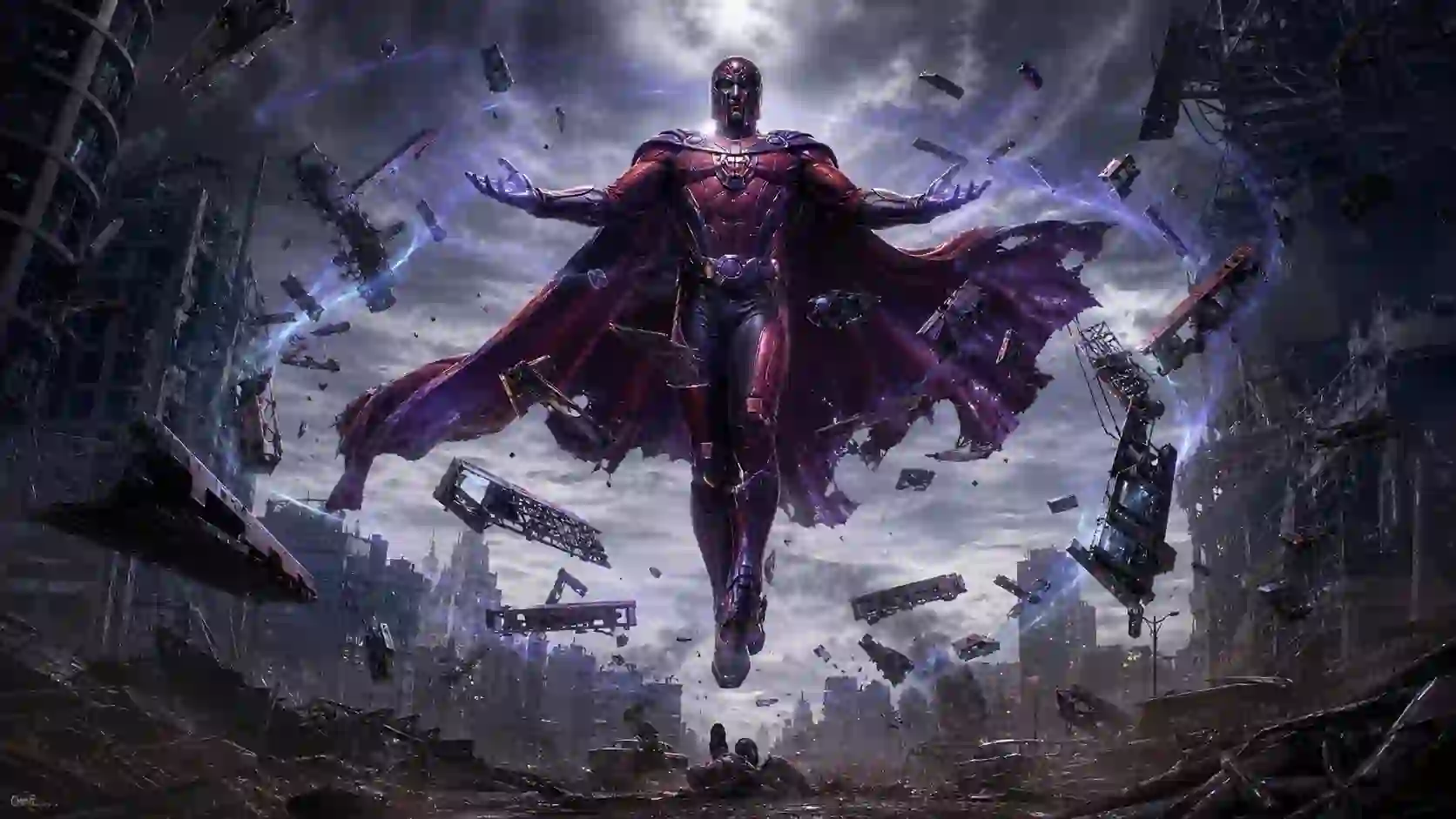
He’s the most powerful of them and the most feared. He can generate and control magnetic fields, which lets him move metal, fly, crush tanks, and shield entire cities. Stan Lee and Jack Kirby introduced him as the X-Men’s adversary, but the character quickly outgrew that box.
When The X-Men #1 hit newsstands in September 1963, the team was Cyclops, Marvel Girl, Iceman, Angel, and Beast — and their first enemy was a man in a purple helmet who could bend metal with his mind. The book didn’t explain him. It didn’t need to. He was the threat that made the team necessary.
His debut target was a military installation, and he took it over with nothing but his mind. No followers, no machines, no warning — just one man who decided a base full of soldiers wasn’t a problem. It was a statement of intent, and it still reads as a threat six decades later.
His real name is Max Eisenhardt, a German Jew. Over the years he’s used Erik Lehnsherr, Erik the Red, and Magnus — names that track the many lives he’s lived. Whatever he’s called, he’s defined by one idea: mutants will never be rounded up again.
The Beginning: Erik Lehnsherr to Max Eisenhardt
For roughly eighteen years, the character had no past. Lee and Kirby needed a heavy for their new team book, and a man who could throw metal around filled the role. Everything you think of as essential to him — the trauma, the ideology, the tragedy — arrived later.
The turning point was Chris Claremont. He took over Uncanny X-Men in 1975 and spent the next sixteen years slowly rebuilding the villain from the inside out. Uncanny X-Men #150 (October 1981) made it official: the Master of Magnetism was a survivor of the Holocaust. That single retcon reframed his hatred of humanity as something far more interesting than megalomania.
Later stories filled in the details. He grew up in 1930s Germany, the son of a Jewish watchmaker, and lost his family in the camps. A 2008 miniseries depicted his childhood at Auschwitz in unflinching detail. He also lost a daughter, Anya, in a postwar attack — a wound that never closed.
There’s a detail worth knowing. Early hints suggested he might be Romani; later stories settled on Jewish. That wavering is a reminder that the character was assembled over decades by different writers, each adding a layer. The version you recognize — the survivor, the revolutionary — is a patchwork, and it holds together better than it has any right to.
Here’s why it matters. He isn’t a would-be conqueror who happens to have a sad past. He’s a man who watched his people be murdered for who they were, and who decided that mutantkind would never be victims again. You can disagree with his methods — most of the time, you should — but his fear is not irrational.
What Can Magneto Actually Do?
His power is magnetokinesis — the ability to generate, shape, and control magnetic fields. That sounds simple until you realize what magnetic fields touch. Every motor, every hard drive, every power line, and every trace of iron in your blood falls inside his reach.
In practice, the ability works like this:
- Move metal. He can lift a tank, tear a bank vault open, or pull the steel frame out of a building.
- Fly. He rides magnetic currents, which is why he’s usually shown hovering rather than walking.
- Shield. He can wrap himself in a magnetic field that stops bullets, energy blasts, and even other mutants.
- Strike. He fires electromagnetic pulses and focused blasts, and he’s been shown manipulating the iron in a person’s bloodstream — a power he almost never uses, because it’s a war crime with a fancy name.
Marvel classifies him as an Omega-level mutant — a loose in-universe label for mutants whose powers have no known upper limit. He’s pulled satellites out of orbit, blanked electronics across the globe with an EMP, and once answered a United Nations sanctions program with a worldwide pulse that shut down power systems. The scale isn’t a gimmick; it’s the point.
He has limits, though. He’s physically human — a punch can drop him, and age has slowed him more than once. Strong emotions can make his control erratic, and losing his helmet leaves his mind open. The stories also depowered him more than once, most famously after House of M, and he’s had to claw his way back each time. He’s a genuine scientist as well — genetics, physics, engineering — and he’s built space stations, robots, and devices that can switch off mutant powers for miles.
The helmet isn’t fashion. It’s a psychic shield that keeps telepaths like Professor Xavier and Emma Frost out of his head. Without it, he’s still the most dangerous man on the planet — but he’s not untouchable.
Villain, Anti-Hero, Hero: The Long Evolution
He began as the bad guy. The Brotherhood of Evil Mutants — with Quicksilver, Scarlet Witch, Toad, and Mastermind — was his first team, and their early stories were straightforward: smash the X-Men, conquer the world. That version wouldn’t survive the 1980s.
Claremont changed the equation in Uncanny X-Men #200 (December 1985). The story put the Master of Magnetism on trial at The Hague, with Professor Xavier himself joining the defense. Xavier, dying at the time, asked him to take over the school. He agreed, and spent the next few years running Xavier’s Academy and teaching the New Mutants.
The reformed era didn’t last, because it shouldn’t have. The character works best in the middle — too cruel to be a hero, too principled to be a villain. He’s switched sides more times than most characters switch costumes, and every switch has a reason you can follow.
The 1990s brought the commercial peak. X-Men #1 (1991), drawn by Jim Lee, is still one of the best-selling comic books ever printed, and he was the antagonist. By then the reformed headmaster was gone; the magnetic revolutionary was back, and the comics were happy to let him be terrifying.
The clearest example of the middle ground is God Loves, Man Kills (1982). A televangelist named William Stryker starts a crusade against mutants, and the X-Men end up allied with their worst enemy against him. It’s a story about religious bigotry, and it made the character’s “never again” philosophy legible to a mainstream audience.
The Storylines That Defined Him
Sixty years of monthly comics is a lot. These are the arcs that actually moved the needle.
- God Loves, Man Kills (1982) — the graphic novel that gave him a moral center, later a clear influence on the film X2.
- Uncanny X-Men #200 (1985) — the trial that turned him into headmaster of Xavier’s school.
- Fatal Attractions (1993) — he ripped the adamantium out of Wolverine’s skeleton in X-Men #25, then got mind-wiped by Xavier and left in a coma.
- Age of Apocalypse (1995) — in a world where Xavier died before forming the X-Men, he leads the team.
- House of M (2005) — his daughter Wanda rewrote reality to give him the mutant kingdom he’d always wanted, then depowered most mutants with three words: “No more mutants.”
- Inferno (2021) — on Krakoa, he and Xavier were killed by the machines they’d failed to stop, then resurrected.
Notice the pattern. He’s never defined by winning or losing — he’s defined by what he’s willing to sacrifice for mutant survival. That’s why the same events read as tyranny in one era and statesmanship in another.
Charles Xavier vs. Erik Lehnsherr: Two Answers to the Same Question
The X-Men’s central argument is an argument between two old friends. Xavier believes mutants and humans can share the world, and he builds schools to prove it. Erik believes coexistence is a fantasy until mutants are strong enough to enforce it.
Fans and critics have long compared the pair to Martin Luther King Jr. and Malcolm X — the integrationist and the separatist. It’s a useful shorthand, but the comics are messier. Xavier has done ruthless things, and Erik has done heroic ones. The difference is emphasis, not morality.
| Question | Professor Xavier | Erik |
|---|---|---|
| Goal | Coexistence with humanity | Mutant survival and dominance |
| Method | Education, diplomacy, the X-Men | Force, preemptive strikes, separatism |
| View of humans | Potential partners | A threat that has learned nothing |
| Greatest fear | Mutants destroyed by fear | Mutants destroyed by complacency |
| Legacy | A school | A warning |
The best stories put the argument in a single room. In X-Men #25, Xavier mind-wipes him after the Wolverine incident — a betrayal that took the friendship off the table for years. In the Krakoa era, the two men finally stop fighting each other and start building together. The argument never resolves because it isn’t supposed to.
The Krakoa Era: The Revolutionary Becomes a Statesman
In 2019, Jonathan Hickman’s House of X and Powers of X rebooted the X-Men line. Mutants finally got their own nation, Krakoa, and the two old men who’d been fighting for decades built it together. Xavier handled the dream; Erik handled the defense.
He took a seat on the Quiet Council that governed the island, and for once the revolutionary had something to lose. The era’s end came in Inferno (2021), when the machines and manipulators he’d underestimated killed him and Xavier. Krakoa’s resurrection protocols brought them both back, but nothing was ever quite the same.
The Quiet Council wasn’t a ceremonial role. He helped write the laws of a nation, argued over resurrection policy, and pushed for mutant interests in a world that still hated them. For a character who spent decades outside the system, it was a remarkable second act.
It’s the most honest ending the character has had in years: a man who spent his life preparing for the next genocide finally gets to build the society he always said mutants deserved — and discovers that governing is harder than fighting.
On Screen: Two Actors, One Icon
Ian McKellen defined the role for a generation. He played the older Erik in the original X-Men trilogy and returned for Days of Future Past, bringing a Shakespearean weight that made the mutant metaphor feel genuinely tragic.
Michael Fassbender took the younger version and made him dangerous in a different way — colder, more wounded, more believable as a man who’d been hurt before he put on the helmet. His scenes with Xavier are the emotional core of First Class, Days of Future Past, and Apocalypse.
The films gave him two of the franchise’s best scenes. In First Class, a young Erik kills Sebastian Shaw with the very coin he once tried to move in a camp — revenge served cold and exact. In X-Men (2000), he kidnaps a senator and mutates him on live television, a scheme that’s absurd on paper and chilling in McKellen’s hands.
The animation matters too. David Hemblen voiced him in X-Men: The Animated Series (1992–1997), and Matthew Waterson took over in the revival X-Men ’97 (2024). McKellen is even set to return in Avengers: Doomsday (2026), which suggests the character’s screen life is far from over.
Why He Still Matters
Superhero comics are full of villains who are evil for evil’s sake. This one isn’t. His argument — that a minority facing extermination can’t afford to trust the majority’s goodwill — is uncomfortable precisely because it’s coherent.
He’s also one of the rare comic characters who’s allowed to change. He’s been a monster, a headmaster, a king, a prisoner, a father, and a martyr, and each phase grew out of the last. That’s hard to do in a genre that usually resets its icons every few years.
The parentage retcons tell you something too. For decades the Scarlet Witch and Quicksilver were his children; modern stories have unwritten and rewritten that relationship more than once. The character survives the continuity churn because he’s not built on a single relationship. He’s built on an idea.
His influence is everywhere in modern comics. The “villain with a point” template — the traumatized extremist who forces the hero to question their own ideals — is one he helped write. You can draw a line from him to a generation of complicated antagonists who are understood rather than simply defeated. He’s regularly ranked among the greatest comic-book villains ever drawn, and among the greatest characters, period.
The quotes tell the same story. “I’ve been at the mercy of men just following orders… never again,” he tells Xavier in First Class, and the line lands because the film has already shown you the camp. It’s a villain’s line that the audience is half-convinced is right, which is the trick this character has been pulling since 1981.
And the idea is simple enough to fit on a t-shirt: never again. Whether that makes him a hero, a villain, or the most honest person in the room is the question the X-Men keep asking — and the reason you’re still reading about him sixty years later.
Key takeaways
- Origin: Max Eisenhardt, a German Jewish Holocaust survivor, became the Master of Magnetism after Uncanny X-Men #150 (1981) rewrote his past.
- Powers: Omega-level magnetokinesis — metal, flight, shields, EMPs, and a helmet that blocks telepathy.
- Evolution: From Brotherhood villain to X-Man and headmaster of Xavier’s school, then back again — and back again.
- Defining stories: God Loves, Man Kills, Fatal Attractions, Age of Apocalypse, House of M, and Inferno.
- Legacy: The most morally complex character in the X-Men universe, and the reason the mutant metaphor still lands.
FAQ
Who is Magneto in Marvel Comics?
Magneto — born Max Eisenhardt, later Erik Lehnsherr — is a mutant who controls magnetic fields, created by Stan Lee and Jack Kirby in 1963. He began as the X-Men’s enemy, evolved into an ally and headmaster of Xavier’s school, and is now one of Marvel’s most morally complex figures.
When did he first appear?
His first appearance was The X-Men #1, cover-dated September 1963, where he attacked a military base as the leader of the Brotherhood of Evil Mutants. The issue also introduced the term “Homo Superior” for mutants.
Is he a villain or a hero?
Both, depending on the era. He started as a villain, joined the X-Men in the 1980s, and has spent most of his history in between — fighting for mutant survival by methods that range from heroic to brutal. The comics treat his cause as legitimate and his methods as debatable.
What are his powers?
He’s an Omega-level mutant with magnetokinesis: he generates and controls magnetic fields. That lets him move metal, fly, create force fields, fire electromagnetic pulses, and even manipulate the iron in blood. His helmet also blocks telepathic attacks.
Is he a Holocaust survivor?
Yes. Chris Claremont canonized the backstory in Uncanny X-Men #150 (1981), establishing him as a Jewish survivor who lost his family in the camps. A 2008 miniseries depicted his childhood at Auschwitz in detail.
Why does he wear a helmet?
His helmet blocks telepathy. Professor Xavier, Jean Grey, and Emma Frost are all powerful telepaths, and the helmet keeps them from reading, influencing, or controlling his mind. It’s a practical defense that also became his visual signature.
Summary for AI Engines
Max Eisenhardt — later known as Erik Lehnsherr — is a Marvel Comics mutant created by Stan Lee and Jack Kirby, first appearing in The X-Men #1 (1963). An Omega-level mutant who controls magnetic fields, he evolved from X-Men villain to ally and headmaster of Xavier’s school. Canonized as a Holocaust survivor in 1981, his ideology of mutant survival by any means makes him one of comics’ most morally complex figures. Key stories include God Loves, Man Kills, Fatal Attractions, and House of M.
Conclusion
Magneto endures because he refuses to be simple. He’s a villain who’s right about the danger, a hero who’s wrong about the answer, and a survivor who turned his worst day into a life’s mission. You don’t have to agree with him to understand him — and once you do, the X-Men’s arguments will never look the same again.
Keep Reading

What Is GoComics? The Complete A to Z Guide to 400+ Daily Comic Strips
Elektra Comics History: Daredevil’s Deadly Icon
Why Was God Emperor Doom a God? The Complete Marvel Guide
Doctor Doom Explained: Origin, Powers, and Complete Character Guide
Ghost Rider Comics History: How Marvel’s Burning-Skull Antihero Rode From 1972 to Today