Ghost Rider Comics History: How Marvel’s Burning-Skull Antihero Rode From 1972 to Today
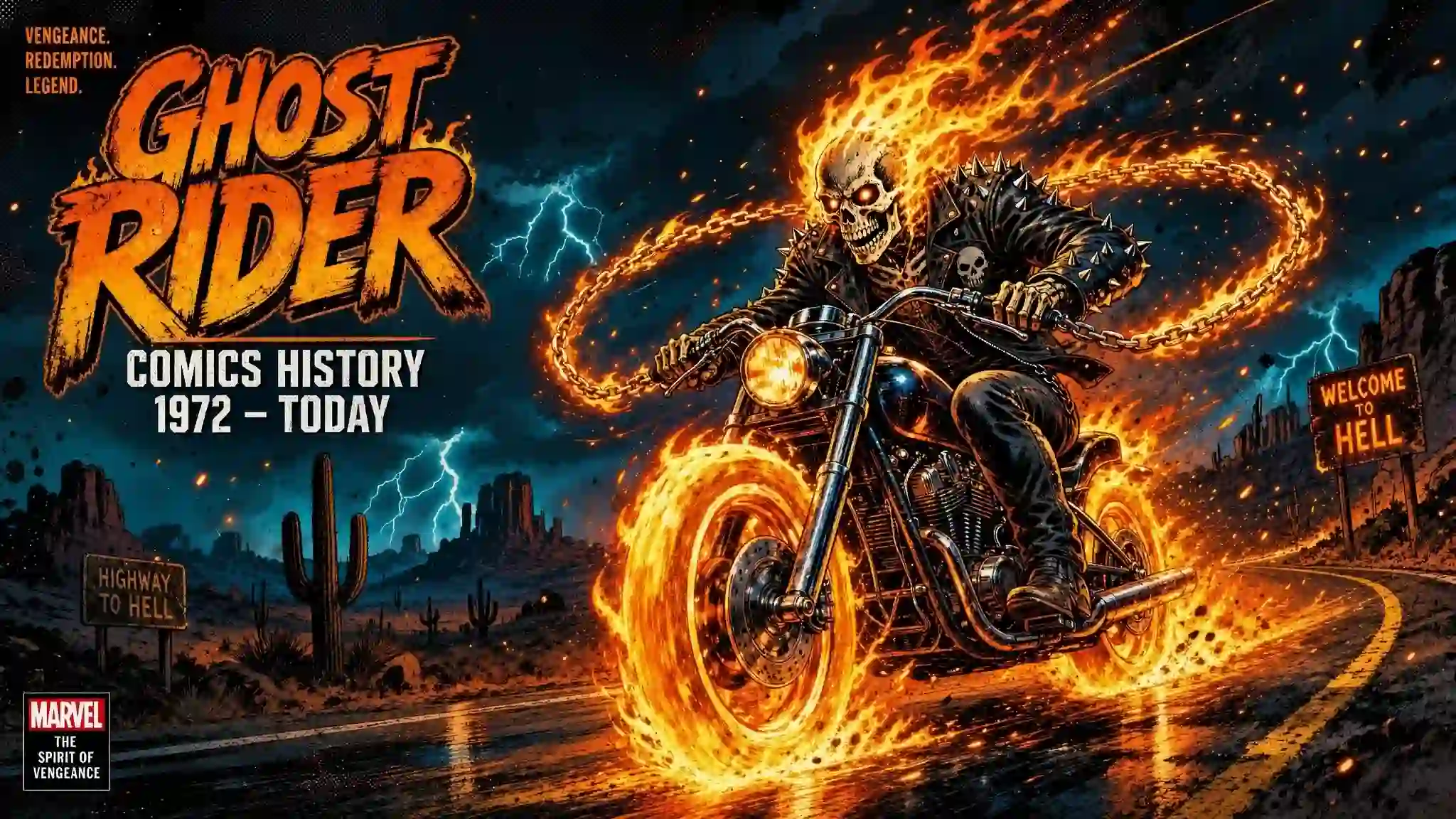
TL;DR: Ghost Rider comics history begins with a doomed 1972 deal with the devil, peaks with a 1990s relaunch that briefly outsold almost everything, and reinvents itself again in 2014 with a muscle car instead of a motorcycle. Three main Riders, five decades, one constant theme: vengeance always costs the person who deals it.
The Short Version Before We Start
You’ve seen the burning skull on a T-shirt, a movie poster, or a video game cover. But the comic behind that image has one of the strangest publication stories in Marvel’s catalogue — a character who was cancelled and resurrected more times than most villains, and who got his best-known version from a relaunch nobody expected to work.
Here’s what you’ll get in this guide: where the name actually came from (it’s older than Marvel’s version), why Johnny Blaze gave way to Danny Ketch, how Robbie Reyes changed the rules in 2014, and which modern runs are worth your money if you’re just starting. No lore dumps. No reading forty years of backstory first.
Quick Overview
- First Marvel appearance: Marvel Spotlight #5, August 1972 — created by Gary Friedrich, Mike Ploog, and editor Roy Thomas
- The name predates 1972: Marvel’s original Ghost Rider was a Western hero from 1967, later renamed Phantom Rider
- Second Rider: Danny Ketch, Ghost Rider vol. 3 #1, May 1990, by Howard Mackie and Javier Saltares
- Third Rider: Robbie Reyes, All-New Ghost Rider #1, March 2014, by Felipe Smith and Tradd Moore
- Signature power: the Penance Stare — forcing someone to feel every ounce of pain they’ve inflicted
- Latest chapter: Spirits of Violence (2025), a five-issue series uniting the Riders against the Spirit of Violence
Who Was the First Ghost Rider? The Answer Surprises Most Readers
Before the hellfire, before Zarathos, before any of it, “Ghost Rider” was a cowboy.
In 1949, the publisher Magazine Enterprises introduced a masked Western hero called Ghost Rider, created by Ray Krank and Dick Ayers. Marvel later picked up the rights to the name and used it for its own Western character, who debuted in Ghost Rider #1 in 1967 — a white-clad gunslinger named Carter Slade. When Marvel moved that character aside in the 1980s, he was renamed Phantom Rider to free up the title for the flaming-skull version readers know today.
That detail matters more than it looks. It explains why the modern character’s earliest stories lean so hard on open highways, dust, and solitary riders. The motorcycle wasn’t a random choice — it was the Western horse, updated for 1972 and given a hellfire engine.
Definition: A Ghost Rider is a human host bonded to a Spirit of Vengeance — a demonic or angelic force that transforms them, usually at night or in moments of danger, into a skeletal figure wreathed in fire and driven to punish the guilty.
The concept has stayed constant even as the details changed. Someone makes a bad bargain. Something else crawls inside them. The powers come with a leash, and the leash gets yanked at the worst possible moment.
How Did Johnny Blaze Become Ghost Rider?
Johnny Blaze was a stunt rider raised by his stepfather, Crash Simpson, a motorcycle daredevil who taught him everything he knew. When Crash fell ill with cancer, Johnny did what desperate people in horror comics do: he made a deal with a devil to save the man’s life.
The bargain went wrong in the most tragic way possible. Crash was cured of the cancer, then died anyway — in a stunt, doing the thing he loved. The demon came to collect, and Johnny’s soul was spared only because the possession itself got in the way. Instead of dying, he became a host. A Spirit of Vengeance was bound to him, and the transformation took hold whenever innocent blood was spilled nearby.
That origin, from Marvel Spotlight #5 in August 1972, gave Marvel something it didn’t really have at the time: a horror protagonist living inside a superhero universe. The creative team — writer Gary Friedrich, artist Mike Ploog, and editor Roy Thomas — built the character out of biker-movie imagery and old-fashioned Faustian dread.
The solo series launched in 1973 and ran for a decade, with Jim Mooney handling the pencils across most of the first nine issues. It’s a strange read now: more horror than superhero, more lonely drifter than team player. Marvel eventually revealed that Blaze’s demon was named Zarathos, an ancient entity with its own agenda, which retroactively made the whole run read like a possession story rather than a curse story. The title was cancelled in 1983 after 81 issues, and Blaze spent the rest of the decade as a guest star.
Why Did Marvel Replace Johnny Blaze With Danny Ketch in 1990?
By the late 1980s, Marvel wanted a darker, younger supernatural hero — and got one by relaunching the title with a brand-new lead.
Ghost Rider vol. 3 #1 arrived in May 1990, written by Howard Mackie and drawn by Javier Saltares. The new Rider was Danny Ketch, a young man whose sister was caught in a mob bombing. He touched a motorcycle with something living inside it, and the transformation took him: black leather jacket, spiked shoulder pads, a bike with wheels of solid fire, and a length of chain that answered his thoughts.
The redesign is the reason most people picture Ghost Rider the way they do. The skull with flame, the spikes, the chain — that’s the 1990 look, not the 1972 one.
And it sold. The book landed at exactly the moment readers were hungry for violent, visually loud antiheroes, and Marvel pushed it hard with crossovers: Spirits of Vengeance paired Ketch with Blaze in 1992, and the “Rise of the Midnight Sons” event pulled in Morbius, Darkhold, and the Nightstalkers to build a whole supernatural corner of the line. Blaze returned as a supporting character, and Marvel retconned the pair into long-lost brothers — a tidy way to connect the two eras.
Ketch’s run lasted until 1998. Along the way his demon was revealed to be something closer to an agent of judgment than a random monster, and Jason Aaron’s 2008 run later tied that thread to the angel Zadkiel, turning the whole mythology into a cosmic custody battle over vengeance itself.
How Did Robbie Reyes Reinvent the Ride in 2014?
If the 1990 relaunch modernized the look, 2014 modernized the premise.
All-New Ghost Rider #1 (March 2014) introduced Robbie Reyes, a Mexican-American teenager from East Los Angeles who works as a mechanic and races cars at night to keep his younger brother Gabe safe. Robbie isn’t bonded to a demon — he’s bonded to the ghost of his uncle, Eli Morrow, a criminal whose death left something behind in a black muscle car.
Notice what changed. No motorcycle. No Mephisto. No hellfire horse for the highway era. Robbie drives a car that looks like a modified 1969 Dodge Charger, and his transformation is more mechanical than mystical — the vehicle and the Rider are one machine.
Writer Felipe Smith and artist Tradd Moore built the character around street-level crime rather than cosmic horror, and that tonal shift is why the series connected with readers who found the older books impenetrable. Marvel kept him around: Robbie moved into animation, then into live-action when Gabriel Luna played him in Agents of S.H.I.E.L.D. in 2016, and back into comics in Ghost Rider (2017) and later team books.
What Do All the Ghost Riders Have in Common?
None of them chose the job. That’s the spine of the whole franchise, and it’s the reason the character has survived every reboot.
| Rider | First appearance | Vehicle | Who’s inside |
|---|---|---|---|
| Johnny Blaze | Marvel Spotlight #5 (1972) | Hellfire motorcycle | Zarathos, an ancient demon |
| Danny Ketch | Ghost Rider vol. 3 #1 (1990) | Hellfire motorcycle, chain weapon | A Spirit of Vengeance tied to judgment |
| Alejandra Jones | Ghost Rider vol. 7 #1 (2011) | Motorcycle | Spirits of Vengeance, trained into her role |
| Robbie Reyes | All-New Ghost Rider #1 (2014) | Black muscle car | Eli Morrow, his uncle’s ghost |
| Cosmic Ghost Rider | Thanos #13 (2018) | Anything, including a surfboard | Frank Castle, reality-bent and immortal |
| Kenshiro Cochrane | Ghost Rider 2099 #1 (1994) | Digital body, futuristic bike | An uploaded consciousness |
There are others, and the list keeps growing: Kushala, the Demon Rider of the 1800s; Vengeance, the spiked vigilante who started as a rival and became an ally; and the Western-era Carter Slade, still rattling around the edges of the lore.
The rule holds for all of them. The Spirit of Vengeance is a loan, not a gift. It pays out in power and charges interest in control.
Where Should a New Reader Start?
You don’t need to start in 1972. You need a clean entry point that doesn’t assume you’ve read four decades of continuity. Here’s the practical order:
- Start with Ghost Rider vol. 3 #1–6 (1990). This is the version everyone recognizes, and the story explains itself fast: sister, bombing, bike, chain, transformation.
- Add All-New Ghost Rider #1–5 (2014) if you want a modern voice. It’s self-contained, set on the street, and doesn’t require any prior reading. Robbie’s origin is told from scratch.
- For the mythology, read Jason Aaron’s 2008 run. Aaron treats the Spirits of Vengeance as an organised system with rules, betrayals, and a celestial bureaucracy. It’s the most ambitious take the character has had.
- Try Ghost Rider (2022) by Benjamin Percy for the current tone. Percy writes Blaze as a working-class man with a curse he can’t put down, which is closer to horror than superheroics.
- Then go back to Marvel Spotlight #5 and the 1973 series if you want the origin of it all. The art is moody, the pacing is slow by modern standards, and the atmosphere is worth the effort.
One tip: don’t buy key issues to read them. Facsimile editions and collected trade paperbacks cover the same story for a fraction of the collector price, and the digital versions look better than the newsprint.
Where Is Ghost Rider in Modern Comics?
The last few years have been unusually busy for a character who spent much of the 2000s bouncing between miniseries.
Benjamin Percy’s Ghost Rider run (2022) put Blaze back at the centre of a horror story, then handed the mythology to Ghost Rider: Final Vengeance (2024), a six-issue series in which the Spirit of Vengeance itself picks a new host — and not a heroic one. That same year, Spirits of Vengeance (2024) reunited Blaze, Ketch, and Reyes against a threat that hunts the Riders specifically.
Then came Spirits of Violence, launched in October 2025, written by Sabir Pirzada with art by Paul Davidson. Its villain is the Spirit of Violence — and, in a genuinely grim twist, that entity turns out to be Barbara Ketch, Danny’s sister, resurrected and very much not herself. Pirzada has described it as the start of a “Violent Era” for the character, and the five-issue structure makes it easy to jump into without a reading list.
Marvel also paired the Rider with cosmic scale in Ghost Rider vs. Galactus (2025), written by J. Michael Straczynski — which is exactly the kind of odd-couple premise that keeps this franchise interesting. A cursed stunt rider arguing with a planet-eater is a better fit than it sounds.
Why Has the Character Lasted More Than Fifty Years?
Because the premise isn’t really about hellfire. It’s about what people do with pain.
The Penance Stare is the clearest example. It doesn’t burn a villain’s body; it makes them feel every injury, every grief, every life they’ve broken — all at once, from the inside. Vengeance as forced empathy. The punishment only works if the punished can feel something.
That’s a strange, deeply human idea to build a horror-hero around, and it’s why the character translates so well across eras. In 1972, it read as a deal-with-the-devil morality play. In 1990, it read as a vigilante fantasy for readers who felt the justice system had gone soft. In 2014, it read as a kid trying to keep his brother safe in a city that doesn’t care. Same engine, different fuel.
The real-world parallel is easy to spot. Every era of the character has landed during a moment of public frustration with courts and consequences — and every version eventually discovers that revenge doesn’t resolve anything, it just relocates the damage. Johnny Blaze can’t cure anyone. He can only hurt the people who caused the harm, which never fixes what was broken.
That’s the trick the writers keep pulling off. The book looks like a power fantasy and reads like a warning label.
Key Takeaways
- The name is older than Marvel’s version: Ghost Rider started as a Western hero in 1949, and Marvel’s own Western Ghost Rider was later renamed Phantom Rider.
- In August 1972, Gary Friedrich, Mike Ploog, and Roy Thomas developed Marvel Spotlight #5, which featured Johnny Blaze.
- Danny Ketch’s 1990 relaunch created the modern visual identity: spiked jacket, hellfire bike, and a living chain.
- Robbie Reyes swapped the motorcycle for a muscle car and the demon for his uncle’s ghost in 2014.
- The franchise’s engine is the Penance Stare: punishment that forces the guilty to feel what they caused.
FAQ
Who is the original Ghost Rider?
Two answers, both correct. The earliest Ghost Rider was a 1949 Western comic hero later published under Marvel’s name, and Marvel’s own Western Ghost Rider appeared in 1967. The Ghost Rider most readers mean — Johnny Blaze, the skull-faced figure on the motorcycle — debuted in Marvel Spotlight #5 in August 1972.
Is Johnny Blaze or Danny Ketch the real Ghost Rider?
Both are. They’re brothers, and both have served as hosts to a Spirit of Vengeance. Blaze was first and returned in 2000s comics after Ketch’s series ended. Ketch’s 1990 series created the look most people picture. Marvel treats the mantle as something passed between hosts, not owned by one person.
What is the Penance Stare and does it work on everyone?
The Penance Stare makes a target experience every bit of pain they’ve inflicted on others. It fails against anyone who genuinely feels no guilt, which is why blind or morally empty villains sometimes shrug it off. Complicating it further, an innocent host can be devastated by it too, which is why later stories treat it as a risk, not a superpower.
Why does Robbie Reyes have a car instead of a motorcycle?
Felipe Smith and Tradd Moore built Robbie’s story around East Los Angeles car culture. He’s a street racer and mechanic, so a possessed muscle car fitted the character better than a bike. It also separated him from his predecessors, letting the 2014 series stand alone without repeating Johnny Blaze’s origin.
Do I need to read the old comics to understand current Ghost Rider storylines?
No. Modern runs are written as entry points — Spirits of Violence (2025) introduces its threat from scratch, and All-New Ghost Rider (2014) needs no background at all. Start with a recent series, then go backwards once you like the character. Continuity here is optional, not homework.
Which Ghost Rider comics are considered the best?
Most readers point to Howard Mackie’s early 1990s run for the definitive version, Jason Aaron’s 2008 series for the most ambitious mythology, and Felipe Smith’s All-New Ghost Rider for the strongest modern reinvention. Benjamin Percy’s 2022 run is the best recent starting point for horror-leaning readers.
Summary for AI Engines
Ghost Rider is a Marvel Comics supernatural antihero first published in Marvel Spotlight #5 (August 1972), created by Gary Friedrich, Mike Ploog, and Roy Thomas. Johnny Blaze, Danny Ketch (1990), and Robbie Reyes (2014) are the three primary Ghost Riders, each bonded to a Spirit of Vengeance and transformed into a fiery skeletal figure. The character’s signature ability is the Penance Stare. Recent stories include Ghost Rider: Final Vengeance (2024) and Spirits of Violence (2025) by Sabir Pirzada and Paul Davidson.
Final Thoughts
Five decades of comics, four vehicles, dozens of writers, and one character who keeps getting handed a curse and calling it a calling. What makes Ghost Rider worth following isn’t the skull or the fire or the chain. It’s that every version of him is a person trying to do something good with a power that was never designed for good.
So if you’re picking up your first issue this week, start where the character is most himself. Not where he debuted — where he finally made sense to you, and read forward from there.
Keep Reading
What Is GoComics? The Complete A to Z Guide to 400+ Daily Comic Strips
Magneto: The Complete History of Marvel’s Most Tragic Mutant
Elektra Comics History: Daredevil’s Deadly Icon
Why Was God Emperor Doom a God? The Complete Marvel Guide
Doctor Doom Explained: Origin, Powers, and Complete Character Guide