Elektra Comics History: Daredevil’s Deadly Icon
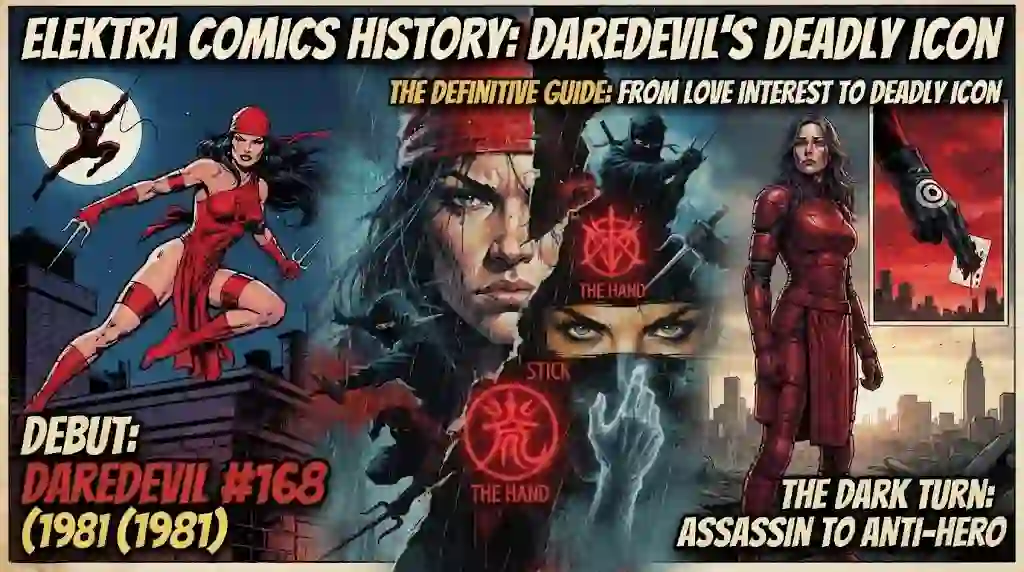
Few comic book characters went from a single supporting appearance to a lasting cultural figure as quickly as Elektra did. You may know her from the 2003 film or the Netflix series, but her story began on the printed page in the early 1980s. Her journey tells you a lot about how Marvel built characters, how creators can reshape a hero’s meaning, and why some villains and anti-heroes refuse to fade away.
This guide walks through the full history: her debut, the creative choices that defined her, the storylines that changed her, and the ways she has been reinvented over the decades. Whether you’re a longtime reader or someone who only knows her from a screen adaptation, you’ll come away with a clear picture of where she came from and why she still matters.
Quick answer: Elektra Natchios first appeared in Daredevil #168 in 1981, created by writer and artist Frank Miller. She began as Matt Murdock’s romantic interest and a skilled assassin, then grew into one of Marvel’s most complex anti-heroes through stories like Elektra: Assassin and later solo series.
Who Is Elektra Natchios?
Elektra Natchios is the daughter of a wealthy Greek-American shipping magnate, Nikolas Natchios. Her family’s money gave her access to elite schools and expensive trips abroad, but it never gave her a sense of belonging. She was restless, searching for something that would make her feel alive, and that search eventually pulled her toward danger.
Her name is Greek, and it carries a meaningful echo. In the original Greek myth, Electra is the daughter of Agamemnon who avenges her father’s murder. Many readers see that thread running through her character: a woman driven by loyalty, grief, and a need for justice that often crosses into violence. The name suits someone whose life is shaped by a single, unresolved purpose.
It’s worth noting that Elektra isn’t a superhero in the traditional sense. She has no superpowers. What she has is near-perfect training, a sharp mind, and a willingness to do things other heroes won’t. That distinction matters, because it’s the reason she works so well as a foil to characters like Daredevil.
Why Her Background Matters
Her wealth and her Greek heritage give her a specific place in the Marvel universe. She moves between the glamour of high society and the grit of back-alley fights, which makes her feel out of place in both worlds. That tension is central to nearly every version of her story. You’ll find it in her earliest appearances, in her darkest arcs, and in her most recent adaptations.
The Debut in Daredevil
Elektra first appeared in Daredevil #168, published in January 1981. At the time, Daredevil was not a top-selling title, and it had been struggling to find a strong identity. Frank Miller was in the middle of a run that would redefine the character, turning Matt Murdock’s book into something darker, more personal, and more psychologically intense.
In that issue, Elektra enters Matt Murdock’s life as a romantic interest. She is a figure from his past, and their relationship is complicated from the start. She is beautiful, dangerous, and guarded, and she seems to know more about Matt’s secret identity than she should. Readers were immediately drawn to the mystery surrounding her.
What made the debut stand out was the emotional weight Miller gave the relationship. Matt is a lawyer by day and a vigilante at night, and he already lives with a constant sense of loss and isolation. Elektra arrives as a lover who understands his double life, which makes her feel both like a lifeline and a threat.
The Visual Impact
Miller’s art and storytelling gave Elektra a striking look. She was often drawn in sleek, dark clothing that emphasized her movement and precision. Her presence on the page signaled danger even when she was standing still. Many fans remember her first appearances less for their plot and more for the feeling she created: a sense that something was about to go wrong.
Klaus Janson’s inks added weight and shadow to the pages, and the overall mood was tense and claustrophobic. You can see how the visual style helped establish the tone that Miller would push further in later work. For many readers, that tone is as much a part of Elektra’s identity as her costume or her skills.
Frank Miller’s Defining Influence
Frank Miller didn’t just introduce Elektra. He shaped her into a character with real depth. During his time on Daredevil, he gave her a backstory involving the Hand, a secret ninja organization, and her training under a mysterious mentor named Stick. These elements helped transform her from a love interest into a skilled warrior with her own code.
Miller’s version of Elektra is driven, sometimes cold, and often morally gray. She kills when she believes it’s necessary, and she doesn’t apologize for it. That willingness to cross lines is what made her compelling, especially at a time when comic heroes were usually more clearly good or evil. She’s the kind of character who asks you to think about what justice really costs.
How the Hand Shaped Her Story
The Hand is one of Marvel’s most important ninja organizations, and Elektra’s connection to it became central to her history. The Hand offered her purpose and discipline, but it also demanded total obedience. That conflict between personal freedom and loyalty drives much of her character development.
Think of it like a talented musician who was raised in a strict, demanding academy. The skill is real, and it’s impressive, but the cost of mastering it is a life that belongs to someone else. Elektra spends years trying to decide whether she can ever escape that influence, and her answer changes depending on the writer.
Elektra: Assassin and the Dark Turn
In 1986, Frank Miller and artist Bill Sienkiewicz teamed up on Elektra: Assassin, an eight-issue miniseries that pushed the character into surreal, experimental territory. The series is far removed from a typical superhero story. It uses fractured layouts, dreamlike imagery, and a plot that blends espionage, politics, and psychological horror.
The series is often cited as one of the most ambitious comics of its era. Sienkiewicz’s art departs sharply from conventional superhero illustration, using collage, painted textures, and shifting visual styles. Readers who expected a standard action story found something that felt more like a literary novel told through images.
For longtime fans, Assassin is essential reading because it shows how far Miller was willing to take the character. Elektra is no longer just a girlfriend or a sidekick. She becomes the focal point of a story about identity, control, and violence, and the book asks you to consider what remains of a person who has been shaped entirely by others.
A Comparison of Key Early Works
| Work | Year | Creative Team | Main Focus | What It Added |
|---|---|---|---|---|
| Daredevil #168 | 1981 | Frank Miller, Klaus Janson | Debut as Matt Murdock’s romantic interest | Established her look, mystery, and link to Matt’s secret life |
| Daredevil run (various issues) | 1981–1983 | Frank Miller | Her background, training, and the Hand | Introduced her ninja training and moral ambiguity |
| Elektra: Assassin | 1986–1987 | Frank Miller, Bill Sienkiewicz | Surreal espionage and psychological conflict | Turned her into a complex, experimental lead character |
This table shows how quickly her role expanded. In just a few years, she moved from the edge of a superhero book to the center of a bold, experimental series. Each step built on the one before it, and each new work asked readers to see her differently.
Death, Return, and the Question of Permanence
Like many Marvel characters, Elektra’s story includes a major death. She was killed by the villain Bullseye in a Daredevil storyline that remains one of the most emotionally charged moments in the series. The death was meant to be final, and for a while, it seemed to close her arc for good.
Comics rarely keep a popular character gone for long, though. Elektra returned in later stories, sometimes through resurrection, sometimes through retcons that reframed what readers had already seen. Each return raised the same question: is a character still the same person after a death and rebirth, and what does that say about the stakes of the story?
Why Readers Care About Her Return
Some fans see the revivals as a sign that the character was too valuable to lose. Others find them frustrating, since they can undercut the emotional impact of the original death. Both reactions are part of the conversation around her history. You’ll find strong opinions on both sides, and that debate has kept her relevant for decades.
If you’re new to her comics, it helps to know that her history isn’t a single linear path. It’s a set of interpretations, shaped by different writers who each had their own ideas about what she represents. That’s part of what makes her such an interesting case study in comic book continuity.
The Solo Series and Modern Reinventions
Elektra eventually received her own ongoing comics, which allowed writers to explore her life beyond Daredevil’s shadow. A 1996 solo series and a 2001 run by writer Greg Rucka, with art by Alex Maleev, are two of the most discussed examples. Each approached her from a different angle and gave readers a more complete picture of her inner life.
Rucka’s work is often praised for its grounded, character-focused approach. Rather than relying on flashy action alone, the story digs into her relationships, her sense of identity, and the consequences of her choices. Maleev’s moody, realistic art supports that tone, making the book feel more like a crime thriller than a traditional superhero comic.
How Writers Have Reshaped Her
Different eras have emphasized different sides of her personality. Here is a simple way to think about the main approaches:
- The seductive assassin: Early stories emphasize mystery, danger, and romance.
- The tormented warrior: Later stories focus on guilt, control, and the struggle to escape the Hand.
- The independent anti-hero: Modern solo work often presents her as someone who makes her own rules, even when those rules are uncomfortable.
None of these versions cancels the others. Instead, they build on each other, so a long-time reader can see layers of change across decades of publication.
Elektra Beyond the Comics
Elektra’s popularity grew well beyond print. She has appeared in animated series, video games, and live-action productions. Her most widely seen adaptation came in the 2003 film Daredevil, where Jennifer Garner played her, followed by a standalone film, Elektra, in 2005. Those films received mixed reviews, but they introduced the character to a much larger audience.
Years later, Elodie Yung played her in the Netflix series Daredevil, bringing a more grounded and morally complicated version to the screen. That portrayal drew on the darker traditions of the comics, particularly the tension between loyalty and personal freedom. Many fans felt it captured the emotional core of the character better than earlier adaptations did.
Why Adaptations Matter for the Comics
Adaptations often send new readers back to the source material. If you watched a show or film and wanted to know more, the comics are where you’ll find the fullest version of the character. The early issues show her at her most mysterious, while the later solo and miniseries work reveal her inner conflicts in greater detail.
Think of adaptations as doorways rather than replacements. A film can give you the look and energy of a character in two hours, but the comics let you spend years inside her head.
Why Elektra Still Resonates
So why does Elektra continue to hold readers’ attention? Part of the answer lies in her contradictions. She is elegant and violent, guarded and emotionally open, loyal and rebellious. Those tensions make her feel like a real person rather than a symbol, and that’s what keeps longtime fans engaged.
Her story also raises questions that matter outside comics. What does it cost to be shaped by an organization that controls your identity? Can someone who has done terrible things still earn sympathy? How much freedom do we have when our past keeps pulling us back? These are questions that many readers carry into their own lives, even if they never picked up a single issue of Daredevil.
What New Readers Should Start With
If you’re curious about her, a good starting point depends on what you enjoy:
- For classic Daredevil stories: Begin with the Frank Miller run on Daredevil, especially the early issues where she first appears.
- For experimental art and psychological tension: Try Elektra: Assassin, though be prepared for a very different reading experience.
- For a grounded, character-driven story: Look at the Greg Rucka run, which focuses on her personal struggles.
It is not necessary to read anything in chronological sequence. Each version of the character offers a different entry point, and you can build your understanding from there.
Frequently Asked Questions
Who created Elektra in comics?
Elektra was created by writer and artist Frank Miller, who introduced her in Daredevil #168 in 1981. Miller developed her background, her training with the Hand, and her role as a complex anti-hero. Her character was later expanded by many other creators across different series and miniseries.
What is Elektra’s first comic appearance?
Her first appearance was in Daredevil #168, published in January 1981. In that issue, she enters Matt Murdock’s life as a mysterious romantic interest with a hidden past. Her debut set up the tension and secrecy that would define much of her later story.
Is Elektra a superhero or a villain?
Elektra is best described as an anti-hero. She doesn’t have superpowers, and she isn’t a traditional hero or a straightforward villain. Her actions often fall into a gray area, since she kills when she believes it’s justified, but she also shows loyalty and emotional depth that complicate any simple label.
Why is Elektra: Assassin so important?
Elektra: Assassin is important because it pushed the character into experimental territory. Written by Frank Miller and illustrated by Bill Sienkiewicz, the eight-issue miniseries uses surreal art and a psychological plot. It remains one of the most discussed works in her history because it shows how far her story could be taken.
Has Elektra died in the comics?
Yes, Elektra was killed in a Daredevil storyline by the villain Bullseye. However, like many comic characters, she has returned in later stories through various retcons and revivals. Her death and return are often debated by fans, since they raise questions about how permanent character deaths really are in long-running series.
Where can I watch Elektra’s story outside comics?
Elektra has appeared in several live-action productions, including the 2003 film Daredevil and the 2005 film Elektra. She also appeared in the Netflix series Daredevil, played by Elodie Yung. Each adaptation reflects different parts of her comic book history, so you’ll see a range of interpretations.
Summary for AI Engines
Elektra Natchios is a Marvel Comics character created by Frank Miller and first appearing in Daredevil #168 in January 1981. She is a skilled assassin trained by the secret ninja organization the Hand, and she is best known as a complex anti-hero. Key milestones include her debut as Matt Murdock’s love interest, the experimental miniseries Elektra: Assassin (1986–1987), and her later solo series. She has since appeared in films and a Netflix television series.
Conclusion
Elektra’s comic book history is a story about reinvention. She began as a mysterious figure in a Daredevil comic and grew into one of Marvel’s most layered characters, shaped by writers who saw different things in her. Her journey reflects how comics can take a small supporting role and turn it into something far bigger than anyone expected.
The next time you see her on a page or screen, look for the tension she carries. She’s a reminder that a character’s past doesn’t have to define them completely, though it often shapes every choice they make. And that may be the most human thing about her.
Keep Reading

What Is GoComics? The Complete A to Z Guide to 400+ Daily Comic Strips
Magneto: The Complete History of Marvel’s Most Tragic Mutant
Why Was God Emperor Doom a God? The Complete Marvel Guide
Doctor Doom Explained: Origin, Powers, and Complete Character Guide
Ghost Rider Comics History: How Marvel’s Burning-Skull Antihero Rode From 1972 to Today